


Mustafa Suleyman’s new team promises us super intelligence “in the service of humanity”. But is this real, or is it the most brutal marketing of the year?
This week, I wanted to tell you about a rather curious move that has been brewing since November of last year. This has gone totally unnoticed. Five months later, it is starting to show the cards, and they are more interesting than they appear at first glance.
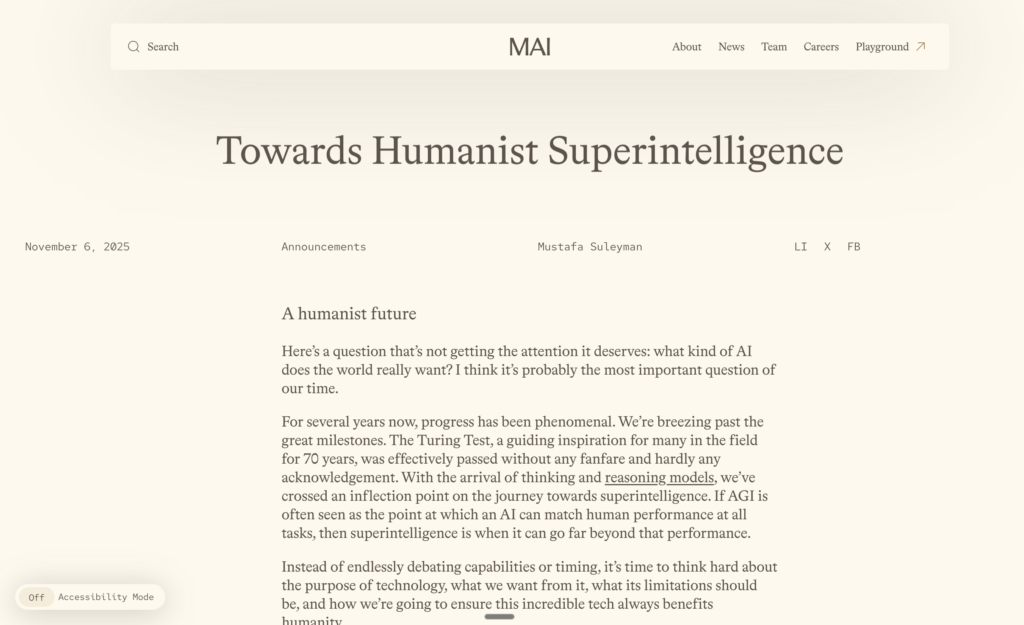
It turns out that on November 6, Mustafa Suleyman (the CEO of Microsoft AI,and co-founder of DeepMind and Inflection) posted on microsoft.ai a manifesto entitled “Towards Humanist Superintelligence”.
In this manifesto, it announced the creation of the MAI Superintelligence Team, with Karén Simonyan as Chief Scientist. It might seem like another one of those announcements that Silicon Valley spits out every now and then, but there is a previous detail that changes the reading.
The September movement that almost nobody saw
A couple of months before the manifesto, in September 2025, Microsoft and OpenAI quietly renegotiated the agreement that had bound them together since 2019. Remember a few weeks ago when we talked about Anthropic and the Pentagon? This is another of those tectonic movements that are rarely seen, but are very relevant.
To make a long story short: the original agreement included a clause that prevented Microsoft from developing AGI on its own; AGI was essentially OpenAI’s exclusive “intellectual property” under that relationship. In the new MOU, Microsoft retains licensing rights to OpenAI models until 2032, but regains the freedom to build its own frontier models. In other words, Microsoft has come out of the closet and is no longer dependent on Sam Altman to play in the big league.
And that’s where the real story begins.
Who Suleyman is (and why it matters what he says)
Suleyman is clearly no upstart. He co-founded DeepMind (the creator of AlphaGo and AlphaFold.) in 2010 along with Demis Hassabis. This was acquired by Google in 2014 for about £500 million. He then founded Inflection AI with Reid Hoffman in 2022(remember I wrote an article related to Pi, the conversational agent of this company).
In March 2024, Microsoft made a very strange move: it did not buy Inflection, but it did sign Suleyman, Simonyan and much of the team, paying a license fee of about $650 million for the technology.
An acquisition in disguise, probably to avoid problems with regulators. As a result, Suleyman took over as CEO of Microsoft AI, reporting to Satya Nadella. Since then, he has been quietly building an alternative to the OpenAI stack within Microsoft.
What the manifesto says (and what it doesn't)
And this is where it gets very interesting. Suleyman explicitly rejects two things: first, the “race to AGI” shared by OpenAI, xAI, Meta, and company; and second, the narrative that pits those who say AI will solve everything against the apocalyptics who say it will wipe out humanity.
Instead, he proposes what he calls Humanist Superintelligence, a superintelligence explicitly designed to serve people, controllable and with concrete applications from minute zero. The most quoted sentence of the manifesto is this: “We are not building an ill-defined and ethereal superintelligence; we are building a practical technology explicitly designed only to serve humanity” (quote).
No abstract AGI, no ethereal promises. Suleyman says that they are already working on what he calls “Medical Superintelligence” and that the next focus will be clean, abundant and cheap energy. On the face of it, it all sounds too nice.
The awkward question
When I read it, I couldn’t help but remember the article I wrote to you a few weeks ago about Jack Dorsey and Block’s layoffs(here’s an article about it), in which we talked about what I called AI-Washing: that habit of wrapping corporate decisions in the gift wrap of artificial intelligence so that the market will applaud.
Microsoft’s could be a much more elegant variant. Let’s call it philosophical AI-Washing: instead of saying “we fire for AI”, the message becomes “we build AI for humanity”. Different packaging, same ultimate goal, differentiate yourself in a saturated market where everyone promises the same thing.
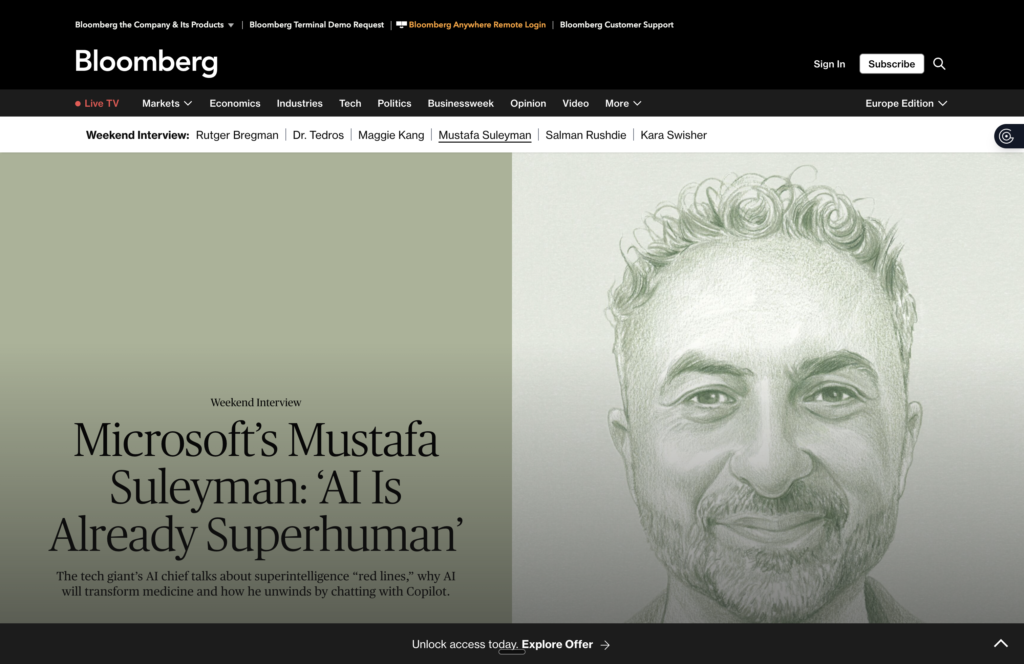
And if that wasn’t enough, Bloomberg later picked up a quote from Suleyman himself that contrasts sharply with the manifesto’s cautious tone: “AI is already superhuman,” he said. Doesn’t sound so controlled, does it?
The answer arrives in April
But here the story takes a very curious turn. It is clear that manifestos can be written in an afternoon, but facts cannot. On April 2, 2026 (just five days ago as I write this), Microsoft announced the launch of three proprietary Frontier Models developed entirely within Microsoft AI, under its own brand, without relying on OpenAI.
And this completely changes my analysis, as none of this looks like “vaporware”. It looks more like a plan executed with discipline. You renegotiate the contract with OpenAI in September; a month later, you publish the manifesto that ideologically justifies your independence; and finally, in April, you present the products that make it a reality…..
After considering it, I believe the “humanist” packaging is clearly marketing-driven. Microsoft needed to differentiate itself in a market where OpenAI dominates the conversation, so positioning itself as “principled AI” is pretty smart, especially for European corporate customers and governments concerned about governance.
On the other hand, even though it is marketing, there is real substance behind it, and this is what, to me, makes it quite different from the Dorsey case. Microsoft is not selling smoke; it is building infrastructure. The three MAI models launched this week are the clearest proof, and having a manifesto, talent, and products at the same time is quite a bit more than these announcements usually offer.
If you are reading this from Spain or any European company, you might think this is another battle between giants far away from you, but it is not. Microsoft is by far the most widely used AI provider by European companies. Copilot in Office 365, Azure OpenAI Service, Teams, GitHub Copilot… pretty much any organization with more than fifty employees is consuming AI through Microsoft, whether they know it or not. If you change your philosophy and start publishing your own models with a different approach than OpenAI, that’s going to come to you sooner than you think.
Do we believe that Microsoft, the company vying for the trillion dollars in capitalization, is really going to build a “humanistic” AI if it means going slower than its competition? I honestly don’t know. I want to believe it will, but I’ve also wanted to believe a lot of things in this industry that then didn’t happen…. What is clear to me is that the movement has started, and that five months after the manifesto there are already three models in operation. Not bad for “just philosophy”.
And in your case, do you believe this Microsoft’s humanistic speech or maybe you see it as a marketing strategy ? I would love to read your comments.
Have a good week!
LINKS OF INTEREST
- Microsoft AI – “Towards Humanist Superintelligence.” (6 November 2025)
- Fortune – “Microsoft, freed from reliance on OpenAI, joins the race for ‘superintelligence'” (November 6, 2025)
- CNBC – “Microsoft forms superintelligence team under AI chief Suleyman ‘to serve humanity'” (6 November 2025)
- Computerworld – “Is Microsoft’s ‘Humanist Superintelligence’ vision more than an empty slogan?” (November 2025)
- Bloomberg – “Microsoft’s Mustafa Suleyman: ‘AI Is Already Superhuman'” (2025)
- TechCrunch -. “Microsoft takes on AI rivals with three new foundational models” (2 April 2026)


