Do you remember when, back in April, I told you that the AGI race was actually two separate races—with the West reduced to three players and China running in its own league? And when, a few days later, DeepSeek spoiled NVIDIA’s party with a model that cost one-sixth as much as the competition? Well, today it’s time to update that thesis, because I didn’t go far enough. It’s no longer two races. It’s a single race, and the third-place contender has decided to do something much more devious than trying to win it: it’s giving away the tickets so the prize is worth nothing.
Let me explain—there’s more to this story than meets the eye.
What Happened
In mid-July, Moonshot AI (a Beijing-based startup that, two years ago, almost no one outside of China had heard of) launched Kimi K3. The numbers speak for themselves: 2.8 trillion parameters with a mixture-of-experts architecture, of which only 16 of 896 experts are activated per token (which is why it can be both massive and inexpensive), and a context window of one million tokens (about four times that of its previous version).
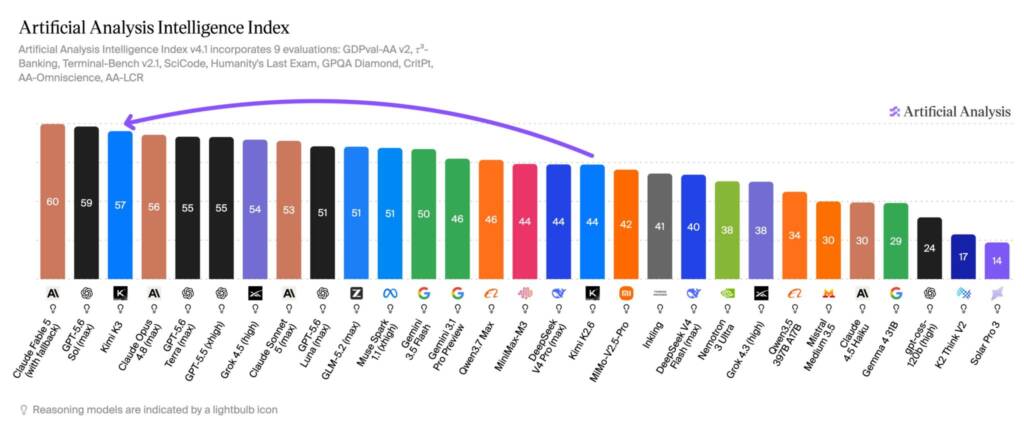
In the aggregate rankings, it has been ranked third in the world, behind only Claude Fable 5 and GPT-5.6 Sol. On Artificial Analysis, it ranks fourth out of 189 models, tied with Opus 4.8.
And in some specific areas, it’s simply in a league of its own. On the SWE Marathon benchmark (related to programming tasks), it scores a 42.0, while GPT-5.5 scores only 14.0—three times higher, plain and simple. It also ranks first in BrowseComp and in agent-based navigation tasks—which is exactly the area I talk about every week.
Nathan Lambert, probably the most serious analyst in the open-source world right now, has described it as “the strongest open-source model ever launched.” As you’ll see, this isn’t just a YouTube headline—it’s coming from someone who works in this field and doesn’t hand out praise lightly.)
It could just be an ad for a new model that breaks benchmarks, but it’s more than that…
The detail that changes everything
The key isn’t in the benchmarks; it’s in the price tag and the timeline. The Kimi K3 API costs $3 per million input tokens and $15 per million output tokens, which is lower than virtually all Western flagship products. And the model weights—the entire model, so you can run it on your own infrastructure without paying a cent to anyone—will be released on July 27. Yes, the very same Monday you’re reading this. While you’re having breakfast, someone in Hangzhou or Munich is downloading a boundary model at no cost.
If this were an isolated move by a startup trying to carve out a niche for itself, it would be aggressive but understandable. The problem is that it’s not an isolated move. The very same week of the launch, Xi Jinping himself committed the future of China’s AI ecosystem to open source and its global dissemination at the World AI Conference. We’re talking about the head of state here, not a CEO looking to make headlines. When the government announces the plan, it’s no longer just a product strategy—it’s something more…
The fact is, China is no longer trying to have the best model in the world; rather, it wants this to stop being a business. Are we talking about technology dumping?
The Numbers That Don't Add Up (For the Usual Suspects)
Think for a moment about how the Western league is funded. OpenAI and Anthropic fund their models with the revenue they generate: every API call, every subscription, every enterprise contract fuels the training of the next model, which in turn justifies the next round of investment and the next data centers. It’s a cycle that keeps going as long as someone pays the entry fee.
Lambert breaks it down piece by piece in his analysis: every open-source frontier model squeezes the margins of commercial labs, leaving less profit to reinvest, which depresses the market’s valuation of those labs and slows investment in infrastructure. The Chinese model doesn’t have to be better; it just has to be good enough and free enough that a portion of the market stops paying. In other words, they’re not sinking your ship—they’re draining the water from the harbor.
On top of that—and this is what strikes me as the most serious issue—they’re doing it with a level of capital efficiency that’s downright frightening: Kimi K3 achieves a nearly 2.5-fold improvement in scaling efficiency compared to its predecessor, using far less money and fewer chips than its American rivals. And sanctions and export controls were supposed to prevent exactly this.
And do you remember that a few weeks ago I told you that Microsoft and Uber’s agent costs had gotten out of hand? Put the two pieces together: Western customers are starting to scrutinize their bills just as a provider comes along that’s giving away its products for free. You don’t need an MBA to see where that’s pushing prices…
It's caused quite a stir in Washington
The American reaction has been straight out of the crisis playbook. David Sacks, the White House’s AI advisor, acknowledged in Axios that he finds China’s leadership in code benchmarks “concerning,” and made a remark that sums up the underlying panic: “This is how you lose the AI race.” His solution, incidentally, is less regulation for American labs—exactly the opposite of what Anthropic is calling for. In other words, they can’t even agree among themselves on how to respond.
And all of this comes at the worst possible time for OpenAI, with Apple suing it for theft of trade secrets in a case that, according to Bloomberg, threatens its plans for its own device. Basically, while the two giants from Cupertino and San Francisco are fighting it out in court over who copied whom, Beijing has thrown open the gates and is letting everyone in for free. It’s downright mocking, honestly.
My thoughts on this matter
I’m going to take a chance—that’s what my blog is for.
To begin with, I think this move is far more dangerous for Silicon Valley than any benchmark. You can respond to a better competitor with a better model; you can only respond to a competitor that gives away its product by changing your business model. And that shift—toward devices, applications, vertical agents, and services—is exactly what we’re seeing OpenAI attempt with its hardware and Anthropic with its agents. Apple’s lawsuit takes on a whole new meaning when viewed through this lens, don’t you think?
On the other hand, the temptation of the “free open-source model” should be taken with a grain of salt. It’s one thing to run open-source models on YOUR server, under your control and in compliance with your GDPR, but it’s quite another to send your customers’ data to an API in China just because it’s cheaper.
The first is a serious option that we in Europe should consider without hesitation. The second, for most Spanish companies I know, is a resounding “no.” If you’re considering the cost savings, first look at where the model is implemented and who has access to the data, and then we’ll talk about the price.
And finally, the correction I owed you: In April, I told you that China was playing in its own league, as if it were a parallel tournament that didn’t affect our day-to-day lives. My mistake: They’re playing in our league, on our field, and under our pricing rules—only they’ve decided to give away the tickets. Whoever can afford it will take home the cup; meanwhile, they’re eating into the stadium’s profits.
Three months ago, this was just a theory for analysts. Today, it’s a download of 2.8 trillion parameters at the push of a button.
What would you do? Would you put a Chinese open-source model at the heart of your company, even if it were free? Leave me your comments—I’d love to hear from you.
Have a good week!