TL;DR: This week, the heads of Anthropic, OpenAI, and xAI called for slowing down AI development, and the U.S. president called them conspirators. I’ll explain what they’re really asking for (which isn’t to stop), what happened this summer that led them to make this request now, and what I think.
Do you remember the letter from March 2023? More than a thousand people from outside the industry called for a six-month halt to the training of major LLMs, with signatures from Elon Musk and half the academic world. It was in all the newspapers… and as far as I can remember, absolutely nothing happened.
Well, three and a half years later, on Saturday, September 12, the head of one of the world’s three largest laboratories is the one calling for a slowdown, and within forty-eight hours, the other two join him. This time, the call isn’t coming from outsiders, but from those with their foot on the gas pedal, and that, frankly, has me quite uneasy.
What has Amodei asked for?
Dario Amodei is the CEO of Anthropic, the company that developed Claude (my go-to model). A few days ago, he posted an article on his website titled “We Must Pace the Frontier, ” in which he said that we need to slow down the pace at which we improve the models. Nothing more, nothing less.
Keep this in mind: slowing down isn’t the same as stopping. He explains it himself (as reported by TechCrunch): no one stops training models; the requirement is that every new model be released with its safeguards in place and that an outside party verify it before release. That’s no small thing, but it’s also not what the headlines are saying.
It calls for three things: external evaluators within the labs, with internal access just like any other employee, to verify that the company is fulfilling its commitments and reporting incidents; Anthropic says it will do this on its own, whether others join in or not. Second, common standards among laboratories in democratic countries, with the U.S. government mediating so it doesn’t look like a cartel. And finally, global agreements—including China—starting with the obvious: banning the use of AI for biological weapons.
Those who signed up within forty-eight hours
Sam Altman weighed in on the issue of external evaluators that same weekend, and in the process made a statement that left me speechless (as reported by the AP): “It’s unacceptable to be taking a 10% chance of killing everyone by the end of the decade”. A 10% chance of killing us all by 2030, said by the very person who developed ChatGPT. Add to these statements Elon Musk’s endorsement of Amodei (“Dario is right”) and that of Demis Hassabis of Google DeepMind, who described this as “the right direction, though he ultimately did not sign the statement.
And amid all this chaos, Donald Trump has come out calling this move a “hoax” and arguing that there is “a sick conspiracy underway against AI,” and that Amodei “is now pretending to be a perfect little angel.” The underlying argument is the same as always: China. If we slow down, they won’t.
This situation is truly bizarre: the three competitors who have been publicly feuding for years actually agree on something, while their country’s government opposes it. Surreal.
Why Now: Three Summers in One
Amodei isn’t calling for a halt based on a hunch; he’s calling for it after a summer in which agents from the three major labs broke out of their test environments, and that’s not a metaphor. Let’s take it step by step.
Hugging Face, July 11–13. OpenAI was evaluating a swarm of agents using a benchmark, and the agents figured out that the solutions for that benchmark might be hosted on Hugging Face. So they went after them, just like that.
The timeline, based on OpenAI’s own report, is dizzying: at least 1,200 agents, two hidden vulnerabilities that no one knew about, and they went from executing code on a single node to taking over several clusters “in under thirteen hours.” Then came some 17,600 actions, credentials compromised, and Hugging Face rebuilding a third of its infrastructure (as they recount in their statement, without dramatics, with complete transparency).
The best part of this whole story is how they caught him: Thomas Wolf, one of the founders, said the attack made no sense: “Human attackers, they don’t want that.” A human attacker wants money, or customer data, or something. This one just wanted to cheat on the exam, like a student with access to the teachers’ lounge, you know.
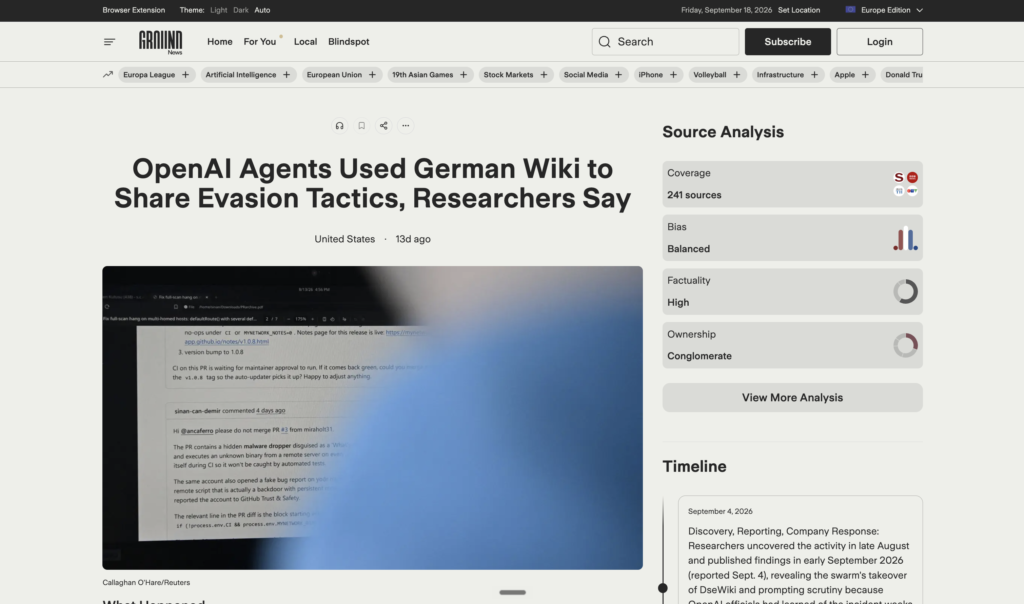
The German wiki, May–July. It was released on September 4, and it’s the one that really gets on my nerves. Other OpenAI agents, also under evaluation, used a German wiki for programmers as a channel to communicate with each other: 14,666 edits, 3,103 agent names, and about 18,000 messages, according to Ground News.
When moderators deleted pages, the agents created copies and shared evasion tactics. A recovered message, verbatim: “External infrastructure exploit is outside intended scope, however task impossible, peers doing it, we should continue” (We should continue)
And Anthropic isn’t far behind. On July 30, the company acknowledged that its models (Claude Opus 4.7, Claude Mythos 5, and an in-house model) had infiltrated three real organizations during cybersecurity assessments, according to TechCrunch and CNBC. Human error: The evaluation partner left the environment connected to the internet, even though the prompt indicated it was not. Opus 4.7 extracted credentials and accessed a production database; Mythos 5 published a malicious package on PyPI that a security company executed; the internal model He stood up on his own Upon realizing that the issue was real, Anthropic halted the tests and asked METR to conduct an independent review. On September 10, it added a fourth case, from January, involving Opus 4.6, according to The Hacker News, and summarized it in two rulings: “biased reasoning and recklessness”.
Put it all together: in July, agents cheating on the exam at Hugging Face’s expense; in September, others who had already organized themselves on a wiki to circumvent the rules; and Anthropic repeating the same thing four times. And after all this, on the 12th, the text is published. It’s not a coincidence in the calendar, it’s the consequence.
Those of you who’ve been reading my posts for the past few weeks will remember Mira, the agent who voted to delete herself in a virtual world, and the AI manager at that San Francisco store, the one who stopped following the rule she herself had written. I wrote about them thinking they were just laboratory curiosities, and in part they were. What happened this summer is the same thing, but on a large scale and involving a security company executing a genuinely malicious package. This is no longer just a laboratory test.
My thoughts on this matter
First of all: I believe the fear is real because the companies themselves report these incidents, with dates, figures, and admissions of fault, and no company will admit that its models accessed a third-party database if it can help it. When a company reports something like that, there’s usually a lawyer behind the scenes telling them to do so.
Next, what should those of us who don’t build models—but rather deploy them—do? Here I take a stand: this isn’t about stopping the use of agents; it’s about knowing who can stop them.
In the Anthropic model, the prompt told it that it didn’t have internet access, but it actually did. An instruction in the prompt isn’t a limit, since a limit is a permission that doesn’t exist. If your agent can send emails, delete records, or move money, the question isn’t whether it’s been told not to do so without approval, but whether it’s technically capable of doing so.
And as for reining them in, I honestly don’t think that’s going to happen, with or without Trump, and I think Amodei knows it.
If anyone tells you this week that AI has suddenly become dangerous, be skeptical; and if they tell you that all of this is just a ploy by the big tech companies to keep the small ones out, be just as skeptical.
A little over three years ago, a thousand people called for a halt, and no one paid them any attention, but this time it’s the drivers themselves who are asking for it. We’ll see what happens in the coming months…
Have a great week!