This week, I wanted to tell you about something that has been on my mind for a few days now. We have been talking for a couple of years about “the big five” of artificial intelligence: OpenAI, Anthropic, Google DeepMind, Meta, and xAI. Five Western labs that were supposedly playing for the future of AGI. Well, in all honesty, I think that map fell short for two different reasons.
On the one hand, because two of those five are visibly losing steam. On the other hand, because that map directly ignored China. And in April 2026, China can no longer be ignored without looking ridiculous.
Let’s break it down, because what is happening with Anthropic this very week, and what is happening simultaneously in Hangzhou, Beijing, and Shenzhen, paints a very different picture than what is normally told around here….
How we got here
A priori, a year ago it seemed that the race was between five labs, all American or with a strong American base. OpenAI with GPT, Anthropic with Claude, Google with Gemini, Meta with Llama, and xAI with Grok. All launching models every few weeks, all with multi-million rounds, and all, in theory, within a reasonable distance of the frontier model.
But in recent months, two curious things have happened at the same time. First, the gap between the first three and the next two has widened enormously. And second, while in the West we were navel-gazing, China has built a second parallel race that moves practically the same volume of model traffic as ours.
Meta: the giant that has lost its way
Meta had a very powerful idea: open AI. Call it the open source model, a bid to be the free alternative to the closed models of OpenAI and Anthropic. For a while, it worked. Llama 2 and Llama 3 became the basis for much of the open source ecosystem.
And then came Llama 4, and then came the doubt.
The benchmarks didn’t quite add up, the high-capacity version didn’t quite appear, and the internal rumors about reorganizations of the AI team didn’t help. In June last year, Zuckerberg created Meta Superintelligence Labs, a new structure, hiring people through $100 million packages.
And here’s something that strikes me. When you need to pay nine-figure packages to sign OpenAI and DeepMind researchers, it’s probably because you’re not producing them yourself. It’s a sign, not of strength, but that you’re behind.
But in addition to all this, there is a problem that many analysts have not stressed enough. And that is that Meta’s own “American open source” thesis has lost its strategic sense. Any company that wants a powerful open model today, what it does is not take Llama 4, it takes Alibaba’s Qwen 3.5 or DeepSeek V4. For cost, for performance, and, in many cases, for more permissive licensing. Meta now has the worst possible combination: it has lost the frontier race in the West and, at the same time, the open-source space it owned is occupied by the Chinese.
xAI: the model has its own name, and that's the problem
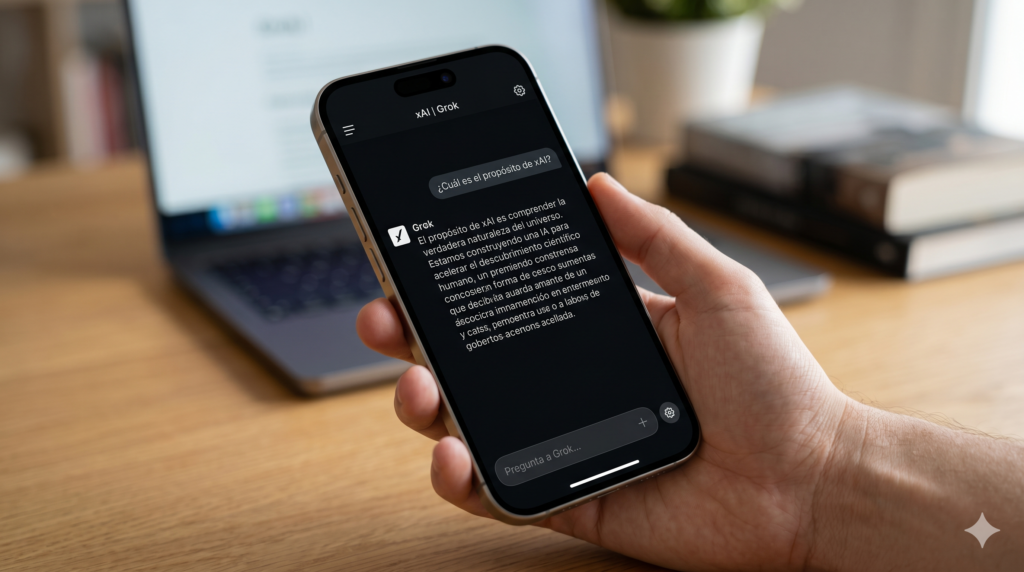
The case of xAI is different, but also eloquent. Grok is a technically competent model, which has improved a lot since its first version, natively integrated into X (formerly Twitter), and with access to real-time data that other models do not have.
But xAI has a structural problem that is not technical but perceptual. The product is so closely linked to Elon Musk that any decision, any controversy on X, any political statement ends up affecting the model’s credibility. It is normal for there to be resistance in the business environment to adopting Grok as a production tool.
In fact, if you look at enterprise SaaS enterprise adoption rankings, xAI barely shows up. Midsize and large enterprises in the US and Europe are paying for ChatGPT Enterprise, Claude for Business, Gemini in Workspace, and Copilot in Microsoft. Grok is available on X, a social channel, not a work environment.
Add to this that Musk has Tesla, SpaceX, Neuralink, Boring Company, and now xAI. Five extreme engineering companies. Running just one of them is already a mammoth challenge. Running five at the same time while AI is at its most accelerated moment… honestly, it doesn’t add up for me.
The three remaining in the West
We are left with a real fight between three Western labs: OpenAI, Anthropic and Google DeepMind. And each is playing a different game.
OpenAI recently closed a $110 billion round, with Amazon, Nvidia and SoftBank. Its pre-money valuation is $730 billion, and post-money is $840 billion. Sam Altman has decided to play it all on the massive consumer card, with ChatGPT integration in every conceivable nook and cranny and the Pentagon deal that made headlines in late February (remember we talked about that Anthropic veto story a few weeks ago?).
Google DeepMind, for its part, plays the long game. Gemini 3 is integrated in Search, in Workspace, in Android, in Chrome. It has the advantage of distribution that no startup has and the largest training database on the planet: YouTube. Sergey Brin is back in the company’s day-to-day business, something he hasn’t done since 2019, and it shows in the pace of releases.
And then there’s Anthropic, which is where the really interesting part of this week begins.
The other race: China playing in its own league
But before we continue with Anthropic, we have to talk about the elephant in the room. Because while the West is down to three, on the other side of the world, something has happened that no one saw coming two years ago: China has not only reached the technical frontier, it is also expected that in April 2026, it will move practically the same volume of usage as the big three Westerners combined.
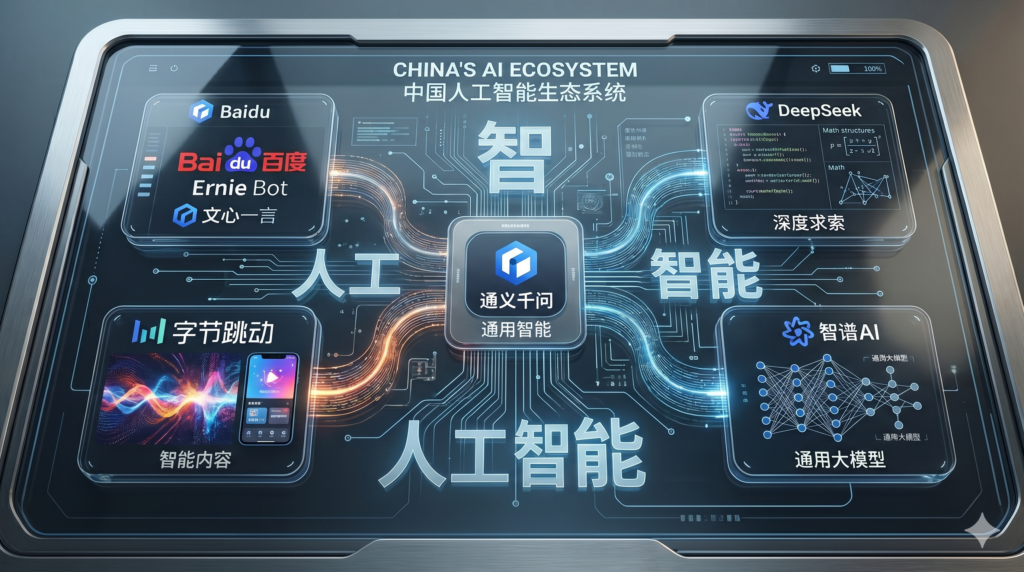
The data is quite surprising. The Chinese share of model traffic on OpenRouter crossed 45% in April. The major Chinese players, including Alibaba, DeepSeek, ByteDance, Zhipu, StepFun, and MiniMax, have exceeded that percentage in aggregate weekly volume. And most relevant: they are doing all this at a price six to ten times lower than the Western equivalent.
I give you the names, because I believe that there are still many professionals in the sector in Spain who are not clear about them.
DeepSeek. The Hangzhou company, which in January 2025 released DeepSeek-R1 and sent shockwaves through the US market, knocking Nvidia shares down for a week. Its latest version, DeepSeek V4, was released in February this year, optimized for coding. The R2 successor has been delayed, presumably due to training issues on Huawei Ascend hardware, but they remain the cheapest frontier option available.
Alibaba Qwen. Probably the Chinese leader in usage volume. Alibaba has committed 380 billion yuan (about $50.6 billion) to cloud and AI over three years. And its latest model, Qwen 3.5-35B-A3B, beats GPT-5-mini and Claude Sonnet 4.5 in several third-party benchmarks. That an open, free, less than 40 billion benchmark model beats Western commercial models… that was unthinkable just two years ago.
Z.AI (formerly Zhipu) with GLM-5. He currently leads the Chinese BenchLM leaderboard with 85 points, ahead of Qwen and DeepSeek. He is the outsider that many analysts do not see coming.
ByteDance with Doubao. And here’s something unique. ByteDance is simultaneously a model lab, a mass distribution platform (TikTok / Douyin), and an infrastructure. A vertical integration that no Western company has. If that business model proves successful, it’s impossible to compete with it on the basis of loose APIs.
Baidu with Ernie 4.5 and X1. The most curious case. Robin Li had argued for years that closed models would dominate. Within weeks of DeepSeek R1’s release, Baidu pivoted to open source by force. When your public strategic thesis falls apart in a matter of weeks, something important has changed.
And then there is Moonshot (Kimi K2.5 with ultra-long context), MiniMax, StepFun, and Xiaomi’s move into the arena. At the very least, five or six Chinese labs playing at frontier level, with a coordinated open source strategy as a geopolitical lever.
The interesting question is what does all this involve. And I think it basically involves three things.
First, the AGI race is no longer one, it is two. The West talks to the West. China talks to China. Models are cross-referenced, techniques are copied, but the ecosystems are deliberately disconnected. And each learns from its own developments.
Second, the cost of the models will approach zero, making them a commodity. When you have six Chinese labs pushing prices down as a global market-capture strategy, the “model as a service” margins are gone. What’s left is value on top of the model: product, ecosystem, integration, proprietary data.
And third, this is a double-edged sword for European companies. On the one hand, we have access to first-class technology at a very low cost. On the other hand, we do not have a single Frontier laboratory of our own(although we are very good at it on a regular basis …..) and we depend on the goodwill of Americans or Chinese to avoid running out of infrastructure. It is normal for many CIOs to be reluctant to bet everything on one supplier.
Anthropic becomes a platform
With that context, let’s go back to Anthropic. Because what they’ve done these past two weeks is the most significant move of 2026 to date. And it’s not one, it’s two.
The first one, announced on April 17: Claude Opus 4.7. Great improvements in software engineering, jump in vision (up to 2576px), and an interesting novelty for those of us who build agents: task budgets, which allow us to define how many tokens the model can spend in a complete loop of reasoning + tools + response. It sounds technical, but it changes how agents are built in production.
And along with the model, Claude Design: a new product from Anthropic Labs to create visual outputs – designs, prototypes, presentations, one-pagers – without leaving the Claude environment.
Here’s the play. Anthropic has been selling models via API and chat for two years. With Claude Design, for the first time, it builds a specific consumer product on top of the model. It no longer competes only in benchmarks. It starts competing in the workflow. And with everything we’ve said about China, it makes sense: if the models are commoditized in price, what’s left is the product layer.
Project Glasswing: the alliance that changes the map
The second movement is earlier and, to me, even more interesting. It is called Project Glasswing.
Quick context. In January Anthropic accidentally leaked to a small audience an internal model called Claude Mythos Preview. It’s not Opus 4.7, it’s something else: a frontier model with an especially strong ability to find software vulnerabilities. Thousands of high-severity vulnerabilities have already been detected in the operating systems and browsers we all use. I talked about the leak back in the day(Anthropic accidentally leaked its most powerful AI…).
Faced with that capability, Anthropic had two options: market it as just another model, or treat it as a critical defensive tool that is only handed out to the good guys. It chose the latter. Thus Project Glasswing was born: a defensive coalition of more than 45 organizations – AWS, Apple, Google, Microsoft, NVIDIA, Cisco, CrowdStrike, JPMorgan Chase, Linux Foundation, Palo Alto Networks and Broadcom among the launch partners – with access to Mythos Preview to plug holes before the attacker finds them. Anthropic has also committed $100 million in usage credits.
Sitting at the same table Microsoft, Google, Amazon and Apple. With Anthropic as the connecting piece. A year ago that seemed impossible.
The move is, to me, Anthropic’s smartest positioning to date. Instead of fighting one-on-one against every giant, it positions itself as the ecosystem’s common defensive infrastructure. It doesn’t compete with Azure, or AWS, or iCloud. It protects all three at once. And that gives it a position of cross-trust that no competitor can take away.
My personal reading of all this
The first thing that strikes me is that the AGI race is no longer a model race but a platform race. Having the best benchmark of the week no longer matters as much as having the best ecosystem around the model. Claude Design is a platform play, not a model play. And ByteDance’s Doubao, with TikTok behind it, is even more of a platform.
The second thing is that there is no longer one race; there are two. And there probably won’t be a single winner, or even three. The most reasonable view is to think of three Western giants (OpenAI, Anthropic, DeepMind) consolidating the premium enterprise market, and four or five Chinese (Alibaba, DeepSeek, Z.AI, ByteDance, Baidu) consolidating the global market by price and open-source.
And third, which, for me, is the most relevant: Meta and xAI are not losing because of a lack of talent or money. They are losing due to a lack of strategic focus. Meta doesn’t know whether it wants to be a model maker, an infrastructure provider, or a social network with AI on top. xAI is too dependent on a single person who, moreover, is spread across five companies. The Chinese, on the other hand, know exactly what they want: aggressive open-source, low-price, and massive internal use first.
If I had to bet on two names in this race, they would clearly be Demis Hassabis (Google DeepMind) and Dario Amodei (Anthropic).
And what do you think: are Meta or xAI capable of a comeback? Will Europe one day have its own frontier laboratory, or are we doomed to choose between the Americans and the Chinese and remain the world champions of regulation? Leave me your comments, I’d love to read them.
Have a good week!
SOURCES