Striving for 0.1% improvements.
Paul McDonagh-Smith Tweet
Aim for improvements of 0.1%. That’s what the professor who’s been teaching me at MIT for years writes on the last line of one of his lecture slides. It doesn’t appear in any of his publications, nor in his webinars, nor on the MIT web pages you can access right now. It’s in class, period. And to me, it’s the most counterintuitive statement I’ve heard in an entire year of discussions about artificial intelligence—a year in which everyone promises you disruption, revolution, and radical transformation before dessert.
Let me tell you where that comes from, because there’s a lot more to it than meets the eye.
The Character
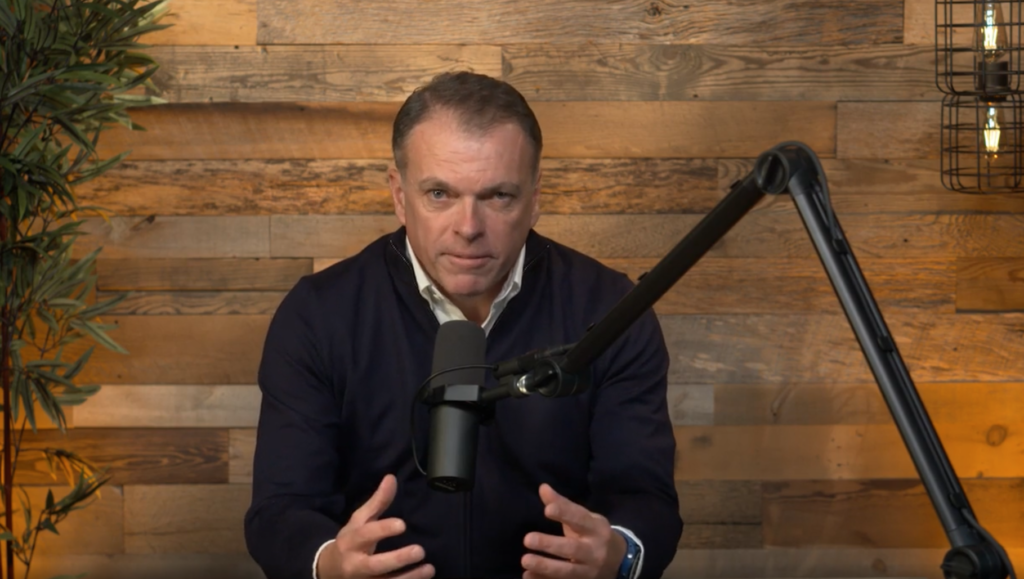
His name is Paul McDonagh-Smith, and he is a Visiting Senior Lecturer in Information Technology at MIT Sloan. He is also an advisor to NASA’s Goddard Space Flight Center, and before all of this, he spent twenty years in the telecommunications industry (Telecom Italia, Cable & Wireless, Nortel, Avaya). He is also the creator of Algorithmic Business Thinking (ABT), which is what I want to talk to you about today.
But first, and I want to make this very clear: Paul has been a role model throughout the years I’ve spent studying in various programs at MIT. He is a teacher in the truest sense of the word, with a vast knowledge of the humanities that goes beyond his technical expertise.
And that’s not just a polite compliment. The fact is, the man who teaches how to translate computer science into business language has a degree in English Language and Literature. You can see it on his resume. In the middle of a conversation about AI agents, he’ll quote T.S. Eliot from memory—and it doesn’t sound forced; it comes across as natural. When I asked him who he really was, beyond his job title, he answered with three words and clarified that all three were lowercase: teacher, technologist, translator. And he added something I jotted down: “I teach because I love to learn” ( I’m keeping that one, Paul).
Where ABT Really Comes From (I Haven't Told You This Before)
I asked him what Algorithmic Business Thinking is, expecting a textbook definition. And he made me wait: “Before I try to answer what it is, maybe I’ll share where it comes from.”
It comes from a book. *Consilience*, by E. O. Wilson, the Harvard biologist, published in 1998. Paul read it, was deeply moved, and built the entire framework around that word. Consilience: the idea of unity, of the unification of knowledge. “ABT is designed with consilience in mind, ” he told me—word for word.
And from there he moved on to the Renaissance—to Michelangelo, to Leonardo, to an era when the humanities and the arts were not divorced from science and technology, but were connected by a bridge. And then, so it wouldn’t seem like we had to go back five centuries, he gave me a much better example: the Industrial Revolution in northern England, where the Romantic poets spent their days “wandering lonely as a cloud” (Wordsworth’s line) and at night, chemistry labs were in full swing.
His thesis is that we were the ones who decided, at some point, that the sciences and the humanities were polar opposites. And that they aren’t. That there is something in the human condition that wants to view science through the eyes of an artist and art through the eyes of a scientist. Everything else—the four pillars, the vocabulary, the methodology—stems from an effort to rebuild that bridge within companies, where, in his words, the technical staff and the business side “were losing touch with one another. Things were getting lost in translation.”
The Four Pillars, in Practice
Let’s get to the content—that’s what you’re interested in.
Paul borrowed four concepts from traditional computational thinking and applied them outside the realm of computer science. They are: decomposition (breaking complex problems down into smaller pieces), pattern recognition (reusing patterns of success—and failure—from one context to another), abstraction (separating the signal from the noise and discarding the superfluous), and algorithms—which is where the twist comes in, because at ABT, an algorithm isn’t a program: it’s humans and machines working in partnership, side by side, as trusted colleagues.
And this is where I have to take a stand—that’s what my blog is for: it’s a model that makes perfect sense. The simplicity of the approach is striking, but it’s also very powerful. It reminds me of the acronym I always use in my classes: KISS— keep it simple…
Well, it turns out I mentioned it to him, and he agreed with me before I even finished my sentence. His defense, word for word, was: “I’d argue that it’s common sense.” And then he looked at me and gave me the silliest yet most effective example I’ve heard in a long time: this morning, when you were getting dressed, you put on your socks before your shoes. You already have a sequential, step-by-step approach to tackling and solving tasks. You already know how to do this.
But right after that comes the part that’s no joke—and which, in my opinion, is the very reason ABT exists: “Common sense doesn’t always translate into common practice.” There it is. We all know how to break down a problem. But almost no one does it in a disciplined way when Monday rolls around and the inbox is overflowing.
Let's go back to 0.1%
The slide I mentioned at the beginning outlines a three-stage journey: from “command & control,” through “collaborate & cultivate,” to “explore & engage.” Just like elite digital professionals. And down there, the line: aiming for 0.1% improvements.
This really struck a chord with me for a very personal reason: I’ve been working for some time with the concept of daily KAIZEN—that Japanese philosophy of tiny, sustained improvement. 1% better every day. And then Paul goes and lowers the bar to 0.1%, which is even more modest—and for that very reason, more credible.
Think about it for a second in the current context. The whole AI narrative is built around the big leap: the model that changes everything, the company that reinvents itself in six months, the agent that replaces an entire department. And an MIT professor—who has every incentive in the world to sell you on the revolution—is telling you to aim for 0.1%.
I’ll stick with 0.1%, to be honest. Among other things, because it’s the only thing I’ve seen that really works.

And this isn't just about AI
Another point I want to make clear—because I think it’s often misunderstood—is that its four fundamental pillars are essential to any transformation process in the field of artificial intelligence, but they can be applied to any technological field.
In fact, they operate outside the realm of technology. I asked him this near the end, when I asked what keeps him up at night, expecting an answer about existential risks or regulation. He replied that he used to wake up a lot at 3:30 in the morning, worried, and that what he does now is exactly that: take the problem, break it down into small parts, make a plan for each part, and go back to sleep. That framework applied at 3:30 in the morning, without a PowerPoint presentation in front of him. That struck me as far more convincing than any case study.
And in case anyone thinks this is something from a few years ago and that the hype has already died down, in March of this year Paul wrote in InformationWeek that the vast majority of jobs, “when decomposed, ” consist of between 15 and 25 main tasks. There you have it: six years later, when it’s his turn to talk about artificial intelligence in a major publication, his first move is still to break things down. It’s not a framework he pulled out of thin air for a course; it’s how he thinks.

What I Asked Him About Agents (and What He Told Me)
Since he was right there, I took the opportunity. I told him that I see companies where each department deploys its own agents—because it’s so easy to do these days, with no layers of communication or security between them—and I asked him how that’s handled.
His response, which I think is the most useful statement in the entire conversation: with agentic AI, we can delegate tasks and activities, but “governance and responsibility cannot be delegated.” Accountability remains with humans—whether within the loop or outside the loop.
He added two more points that I jotted down. The first: we shouldn’t think of autonomy as a switch that you flip on, but rather as a dial—as you increase autonomy, it’s not that governance requirements simply rise, but rather that they multiply. Second, a specific piece of advice for anyone talking to vendors right now: “Don’t pay attention to PowerPoint presentations; pay attention to deployments that actually work.” Ask about real implementations, not demos, because the moment the demo comes into contact with the real world (your data, your people, your integrations), the reality is very different. We’ve already discussed this here when we covered the security aspect of agents, and it fits like a glove.
And from there, he moved on to the electrification of factories—a story I recommend you keep on hand for your next committee meeting. When electricity arrived, Paul explains, it took forty years for productivity to return to its previous level. Why? Because we installed electricity but kept the old architecture: that central shaft that ran through the factory from end to end, distributing hydraulic power and steam. No one questioned it until the next generation of executives came along and asked why on earth that shaft was still there.
I think his conclusion is the best summary of the whole issue, and it comes with a play on words that loses little of its meaning in Spanish: it’s one thing to adopt AI (doing what you were already doing, faster and better) and quite another to adapt to it, which means changing who you become. Almost everyone is doing the former but calling it the latter.
One last bit of nonsense that isn't really nonsense
In every show I’ve done with him, Paul would always start or end our conversations the same way: Go Athletic!
I thought it was an inside joke—the typical courtesy of a teacher who learns a phrase in a student’s native language. Well, no. I asked him about it on camera, and it turns out his wife is from Bilbao, they go to San Mamés whenever they can, and they take it very seriously at home. He ended by wishing the team the best for next season.
There you have it: the founder of algorithmic business thinking, a NASA consultant, an English philologist, a reader of E. O. Wilson… and a fan of Athletic.
0.1% better every day. Hope to see you soon in Spain, Paul.
Have a good week!
LINKS OF INTEREST
- Author’s own interview with Paul McDonagh-Smith, MIT Sloan, Cambridge, Massachusetts, July 31, 2026. All quotations in quotation marks without further attribution are taken from that conversation.
- MIT Sloan — Paul McDonagh-Smith Faculty Profile
- MIT Sloan, Ideas Made to Matter — “Boost Digital Transformation with Algorithmic Business Thinking” (Sept. 30, 2021)
- UNICON — Paul McDonagh-Smith, “Algorithmic Business Thinking: A Suitcase for Digital Destinations” (Feb. 18, 2022)
- MIT Sloan Executive Education — Algorithmic Business Thinking Sprint (current course)
- InformationWeek — Paul McDonagh-Smith, “Metrics of Meaning: What Do We Really Measure in AI?” (March 17, 2026)
- Wikipedia — *Consilience: The Unity of Knowledge*, E. O. Wilson (1998)