TL;DR: Nvidia’s CEO has admitted to his staff that he cheated on his wife, and the story is entangled in an accusation of espionage that China denies and that no one has proven. The board is investigating him, and the stock market has already spoken. What interests me isn’t the gossip, it’s what happens when half an industry depends on a single man.
How is it possible that “base passions” could have caused Huang to let his guard down?
That’s the question I’ve been asking myself ever since I read the email, and I still don’t have an answer that satisfies me. Because we’re talking about the guy who took the stage in San Jose back in March in his leather jacket and told us, with his usual calm, that he expected a trillion dollars in orders by 2027; the man who negotiates with Washington, Beijing, and half the world; the man who, according to Reuters, is the most prolific salesman of the AI boom. And it turns out that what’s putting him on the ropes isn’t a chip, or a competitor, or a regulator…
What Happened, Calmly
On Sunday, November 8, Huang sent an email to Nvidia employees. The sentence that has made headlines around the world is short: “I was unfaithful to my wife.” And a little further down, addressing the staff, the board, and the shareholders, another line that strikes me as even more revealing: “You deserve better from me.”
That same day, the board announced an investigation to be conducted by a committee of independent directors and outside attorneys. They do say, however, that they have no reason to believe that either national security or the company’s secrets have been compromised, that they continue to have confidence in him, and that Huang will remain in charge for the duration.
And why would a board investigate its CEO’s love life? Well, because this didn’t just start on Sunday. On October 29, The New York Times reported that U.S. intelligence believes an executive at Megaspeed, a Singapore-based company that is a client of Nvidia, may have been passing information to China and that she approached Huang. The NYT itself reported that Huang knew nothing about this alleged connection. Beijing denies everything and calls it “smears” against China; there are no formal charges or public evidence, and it’s important to keep that in mind when reading certain headlines.
The press assumes that the relationship described in the email and the one mentioned in the NYT article are one and the same. Based on what has been published from the email, he does not mention any names—
And the stock market, as always, waits for no one
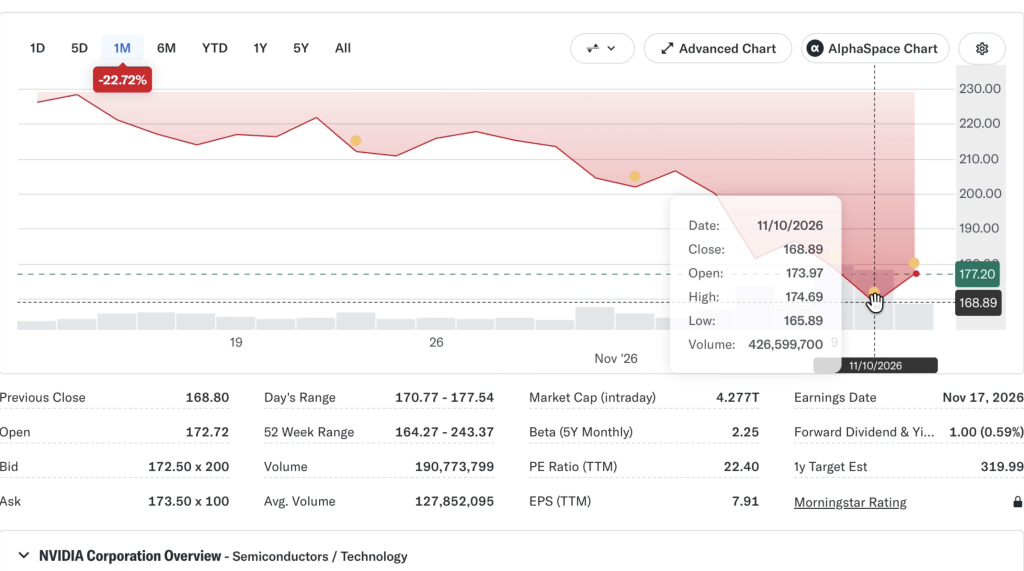
On Monday, Nvidia started the week down nearly 4 percent, and that in a market that had just closed out its worst week in well over a year due to the midterm elections. Reuters summed it up rather bluntly: the markets might be starting to price in the risk that he could be removed from office.
Four percent of the world’s most valuable chip company. All because of an email.
Dan Ives, a partner at Yorkville Ives, called it a “black eye” for Huang in a note to his clients, and posed the question everyone was asking but didn’t dare to voice: Will Jensen remain Nvidia’s CEO? He believes so, in the short term, though he acknowledges that the risk of him being ousted depends on the outcome of the investigation. Add to that the fact that some Republican members of Congress have asked him to testify on November 18, and that Senator Elizabeth Warren says both he and his board owe Congress an explanation. In short, this isn’t going to die down next week.
We've seen this before
Throughout history, we have seen similar cases in which a “scandal” of this kind has had enormous repercussions, just ask the President of the United States about the Lewinsky scandal, for example.
Bill Clinton ended up facing impeachment in the House of Representatives in December 1998, not because of the affair itself, but because he lied about it under oath, and although the Senate acquitted him two months later, his second term was forever tarnished by that incident. Clinton was hurt more by everything that came afterward than by the affair itself, and in Huang’s case, what came afterward is far more serious than a lie: it is the suspicion (for now, just that) that someone may have approached the most influential figure in the AI industry to extract information from him.
Mind you, there might not be anything to it. The council’s investigation might conclude that nothing came of it and that it’s all just a family matter, which is something he has to resolve, not us. But the damage to his reputation has already been done…

The Real Problem: Just One Man
This is where I was going with this.
Do you remember back in March, when I told you all about what Nvidia had unveiled at GTC, and I left you with a question hanging in the air? I wondered if all of that wouldn’t end up making Nvidia too big, too indispensable. Well, it turns out that it wasn’t just the company that was indispensable.
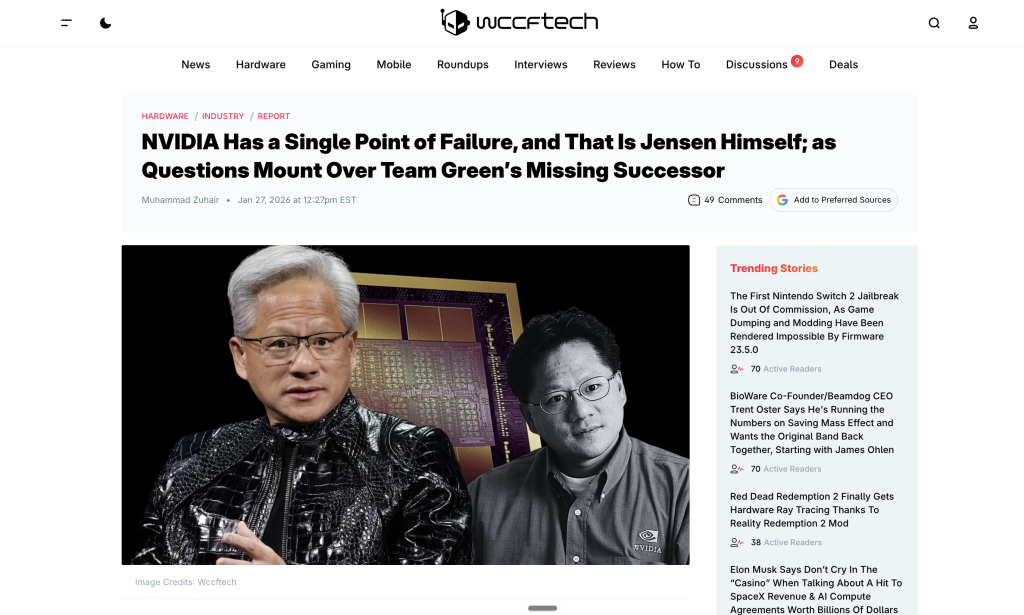
Back in January, Bloomberg reported that Nvidia has no clear succession plans, and Wccftech noted that Huang has more than sixty executives reporting directly to him, with no clear number two in sight. Such a flat organizational structure is one of the reasons for its success (he makes the decisions, he’s involved in everything, he’s the one who sells) and, at the same time, it’s its weakest point; if the person who makes the decisions, is involved in everything, and sells begins to falter, everything that depends on him falters as well. And a huge portion of the world’s AI investment currently hinges on Nvidia.
In the stock market, this is called “key person risk,” and while it’s nothing new, it has rarely been as evident as it has been this week.
My thoughts on this matter
In a company like this, the CEO must keep in mind that it’s not feasible to separate personal life from business, since something like this seriously affects investors due to the company’s stock price decline. This results in losses amounting to millions.
And I know there will be those who think this is meddling in someone’s personal life. I understand that, I really do. But I think we need to draw a distinction.
First of all, I don’t care what Huang does at home, and I’m not going to comment on his marriage because it’s nobody’s business but his own. On the other hand, when you’re the face of a company as valuable as Nvidia, one on which half the industry depends, everything you do comes at a cost that others pay: shareholders, yes, but also the thousands of employees who opened their boss’s email on Monday and the customers who have multi-year investment plans tied to its chips. And finally, there’s what worries me most of all: security. If it’s confirmed that someone tried to get close to him to obtain information (I repeat, if it’s confirmed), we’re no longer talking about a private matter, we’re talking about a security breach at the most strategically important company of the moment.
In a job like this, letting your guard down is not a luxury you can afford. Not even on a Sunday…
What’s clear to me is that, no matter how the investigation turns out, the lesson applies to any company that relies on a single person, even if it doesn’t generate trillions in revenue. Who will make decisions if he’s not around tomorrow? Who knows what he knows?
Huang has a hearing before Congress on November 18. We’ll see what he has to say, and above all, we’ll see what the board says once it’s finished reviewing the matter.
What about you? If the person your company depends on were to be absent tomorrow, would you know who would take over?
Leave me your comments, I’d love to hear from you.
Have a great week!
BREAKING NEWS—Jensen Resigns
I wrote this article before the news broke, and I’m leaving it as is because I think it helps better understand what has happened since.
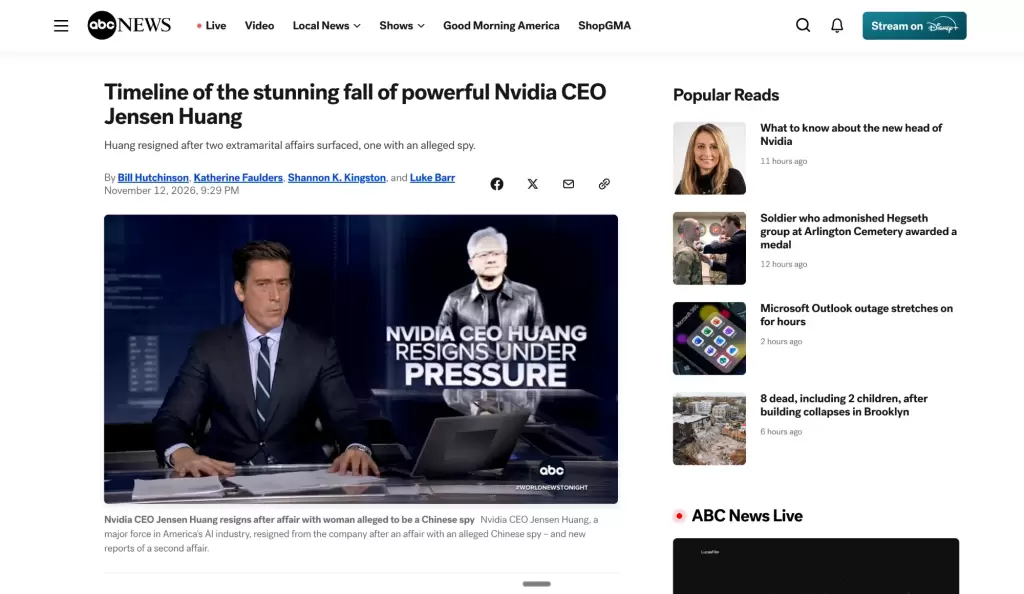
On Thursday, November 12, Nvidia announced that Jensen Huang has resigned as president, CEO, and board member, effective immediately. Thirty-three years at the helm of the company he co-founded in 1993, and it all ends with a press release…
Colette Kress, the chief financial officer since 2013, is serving in the role on an interim basis (while continuing in her current position) as the board searches for a replacement, either from within the company or outside it. There is one detail that strikes me as very significant: Nvidia has appointed Harvey Jones as chairman of the board, a position the company has never had before.
The company has not explained the reason. What is known is that the day before, Reuters reported that the board was meeting to consider his departure, following new reports about a relationship with a female executive who reported directly to him (as reported by Al Jazeera). And the stock market, as always, didn’t wait for anyone: the stock fell by more than 12%.