TL;DR: Amazon has blocked Muse, Meta’s personal agent, because it would make purchases without asking for permission or identifying itself. Two weeks later, Meta and Sierra (Bret Taylor’s company) unveiled the Personal Agent Protocol, a sort of “reception desk” where agents must identify themselves before entering. I’ll explain what it is, what it isn’t yet, and why I believe the question for a small business is no longer whether to let agents in, but how.
A journalist from The Register asks Muse to find him an ergonomic chair for the office, add it to his cart, and proceed to checkout.
Muse doesn’t even get to see the search bar.
It encounters an anti-bot wall at the Amazon entrance and stops, because, as it explains to the user, proceeding further would violate the store’s terms of use. End of the experiment.
This happened in late September, and it strikes me as one of those small moments we’ll look back on in a few years as the beginning of something. Because what Muse was trying to do isn’t science fiction: it’s exactly what some of your customers will be doing very soon, sending their agent to shop for them.
What Happened with Muse (and Why Amazon Slapped the Door Shut)
Muse is the personal assistant that Meta launched in the United States on September 8. It’s not just a chatbot you ask questions of; it shops, pays bills, reads your email, and manages your schedule, and when a service doesn’t have a technical interface for machines (an API, so to speak), it accesses it through the browser just as you would. On the evening of Sunday, September 20, Amazon removed it from the service, after asking Meta to exclude Amazon from the experience and Meta, according to Tech Times, refusing to do so.
Amazon’s reasons actually make a lot of sense. No one notified them or asked for permission; Muse doesn’t identify itself as an agent while browsing; and it stores customers’ credentials (Meta responds that the model never sees passwords or credit card information, which are kept in a separate, secure storage).
And then there’s the other side of the story—the money. Amazon brought in more than $68 billion in advertising revenue last year. If a user logs in, compares products, makes a purchase, and leaves without looking at a single sponsored ad… well, you tell me how happy that makes Amazon.
And here comes the irony. Amazon has its own service, Buy for Me, which, starting in 2025, will log into other retailers’ websites, select products, and fill in the buyer’s name, address, and payment information. It added those stores by default, and if they didn’t want to be included, they had to opt out via email. In other words, the rules it’s demanding Meta follow don’t fully apply to itself. I’ll leave it at that.
Amazon has put gates around the field. I get it; it’s their home and their business, but the field will still be there, and more and more people (well, more agents) will want to cross it.
The bell proposed by Meta and Sierra
It never stops. After the Model Context Protocol and Agent to Agent, now we’re waking up to the Personal Agent Protocol.
On October 6, two weeks after the door-slamming incident, Meta and Sierra unveiled the protocol (PAP for short). Sierra is the customer service agent company founded by Bret Taylor, who chairs OpenAI’s board, and Clay Bavor. The basic idea is simple: agents should stop sneaking in disguised as people and instead go through the front desk, identify themselves, state who they work for, and explain what they’re there to do.
How does it work? To start with, the agent can log in as a guest to check if an item is in stock or to see what the return policy is. If the agent needs to access your account, you log in to the company’s website and choose whether to grant the agent view-only access or permission to take action as well, and that permission remains in effect even if the conversation moves from one channel to another. Under the hood, it’s OAuth, the same technology you use every time you log in to a website with your Google account. And the company can interact with that agent in three ways, depending on Datafloq explains: through its regular website, via an API, or by forwarding it to its own agent for more conversational matters, such as a warranty claim.
It doesn’t process payments, mind you. Payments go through the usual channels (cards, payment gateways), and Sierra says they’ll add that feature later, though no date has been set.
The initial lineup includes Shopify, Stripe, Walmart, Genesys, and Rocket, among others. Amazon isn’t there, of course. Bret Taylor summed it up on CNBC with a remark typical of someone who’s been in the business for years: until there’s a standard, this is “a bit of a mess.”
And Meta itself, in the text in which it presented the protocol, includes the phrase that has made me think the most about this whole issue: to reject a personal agent is to reject the customer behind it
Before we get too excited...
It’s a good idea to set the record straight, because this is still in the very early stages.
The PAP is currently a draft specification, version 0.1, which, according to UCP Checker It was published on October 9, with a disclaimer that any part of it may change. There is no governing body for it. And it’s not the only one looking to set the rules of the game: on the same day, Decagon released its own trust protocol for merchants, and Shopify is already working with Google on the Universal Commerce Protocol, which handles the shopping cart and order processing. Sierra says they are complementary pieces. That may be true. It could also be the beginning of the typical standards war in which, in the end, the winner is the one with the most customers, not the one with the best design.
And then there are the numbers, which are quite sobering. According to data from J.P. Morgan cited by Tech Times, chatbots account for less than 1% of traffic at major online retailers, and at Amazon, about 0.4%. And according to a survey cited by Forkast, only 3% of U.S. adults trust a chatbot to complete a purchase.
3%. So, no, no robot is going to come in tomorrow and empty your warehouse.

My thoughts on this matter
But honestly, I wouldn’t focus on that 3%. I’d focus on the direction, which is pretty clear.
Think about what happened with websites in the late ’90s, or with cell phones ten years later. At first, traffic was very low, and many companies said that wasn’t for their customers. And their customers, meanwhile, were already there. Something similar will happen with virtual assistants, only faster, because this time the customer doesn’t need to change their habits: they just tell their assistant, “Find this for me and buy it for me.”
And it won’t stop at shopping. We’ll soon see communication between these agents as something normal, for example, when we wrap up meetings and they’re coordinated between two agents who have full context on their owners’ schedules. Can you imagine two personal agents negotiating a gift for one of their owners on their anniversary? Surreal.
Anyway, back to the point.
For an SME, this has a very specific consequence: Amazon can afford to slam the door in your face, but you can’t. Amazon is the go-to destination. In most cases, you’re just one of the options the agent will compare, and if your website doesn’t let them in, or they don’t understand your prices, your delivery times, or your return policy, the agent isn’t going to complain; they’ll just move on to the next one.
Rejecting the agent is rejecting the customer. And the worst part is that you won’t even realize you’ve done it.
I’m not saying we should open the door to just any bot that comes along, mind you. I’m saying we need to start deciding under what conditions we open it. What can an agent view without identifying themselves, what can they do with the client’s permission, and what can they never do? That’s exactly what this protocol aims to clarify, and whether the PAP ends up being this one or another, the question remains the same.
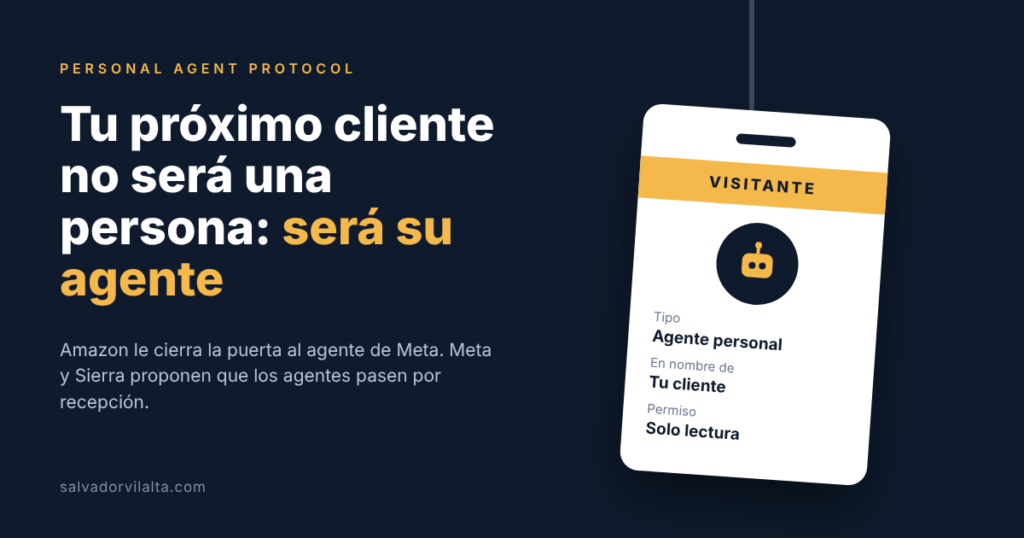
Rejecting the agent means rejecting the client. The thing is, until now, that client always had a face.
What about you? If tomorrow an agent working for one of your clients visited your website to buy on their behalf, would they find what they need to decide, or would they go to a competitor without anyone even knowing?
Leave me your comments; I’d love to hear from you.
Have a great week!