


TL;DR: In South Korea, last Thursday’s college entrance exam had a proctor at every test center whose sole job was to check students’ glasses, because AI-powered glasses can read the exam and give you the answers. And even so, some people still tried. Let me tell you how far this has gone and what high schools, universities, and business schools are doing, though they’re taking quite different approaches.
Ninety-two and a half.
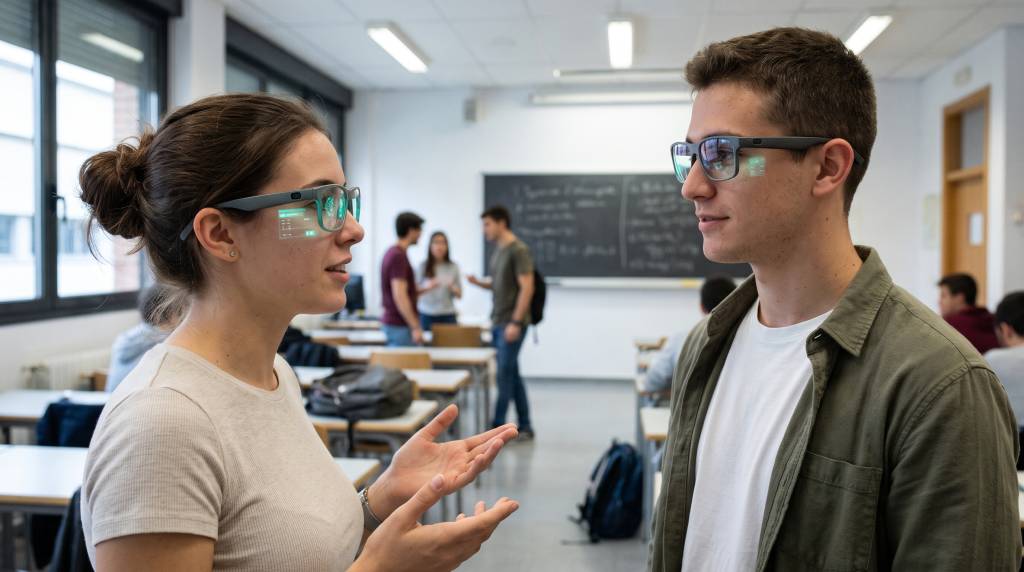
That’s the score achieved by a pair of AI-powered glasses on a degree exam at the Hong Kong University of Science and Technology. Their own engineers set it up last year as a controlled test: the glasses scan the exam paper, send the question to an AI model, and display the answer on the lens. With that, they would have ranked in the top five in a class of over 100 students, where the average was a 72 (according to CNN).
Without studying. Without a cheat sheet. With a pair of glasses that, when viewed from the front, look just like anyone else’s.
What Happened on Thursday in Korea
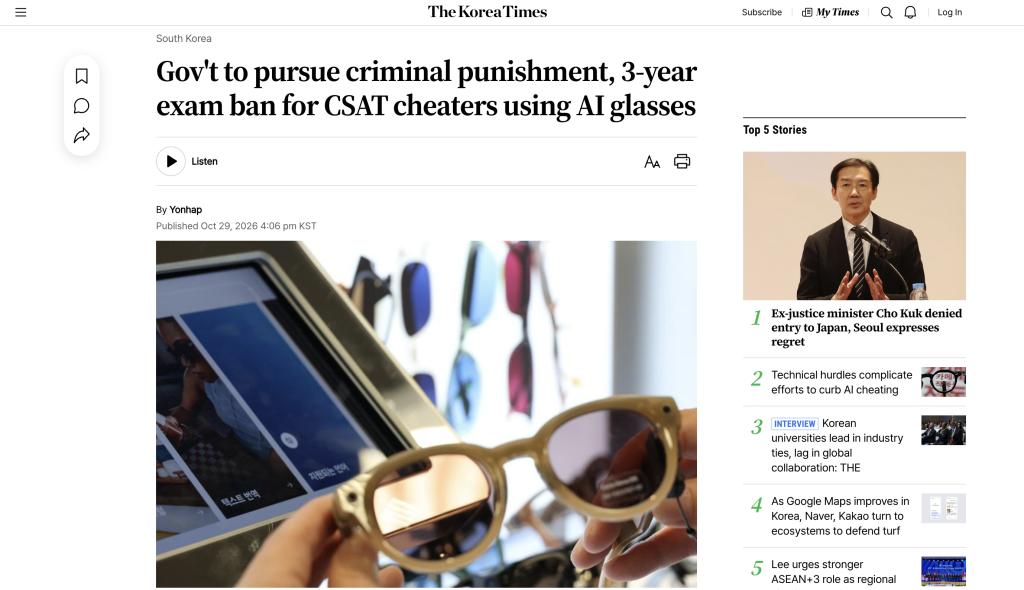
On Thursday, November 19, Korean students took the suneung, the college entrance exam, which is practically a matter of national importance there. And this year, it came with a new development that would have sounded like a joke a couple of years ago: at every test center, there was a person whose job was to keep an eye on the students’ glasses.
The Ministry of Education had announced this in late October. Anyone caught cheating with AI glasses would face criminal charges, and the ban on retaking the exam would be extended from one to three years; the glasses had already been on the list of prohibited items since July, and for next year, authorities are considering installing radio wave detectors in classrooms.
So why all the fuss? Well, because a few days earlier, another suspicion had come to light, this time regarding the tax advisor exam. The highest score was 397.5 out of 400—just one mistake out of 160 questions, and many of the test-takers simply don’t believe it. The government is already talking about “zero tolerance.”
Well, we already know what happened.
There were about 550,000 students taking the exam at 1,312 schools, and, according to the Ministry of Education, 111 were caught with some kind of electronic device on them. Most were simply carrying them. Five used them during the exam: a cell phone to take a picture of the test paper, two others in the restroom, a miniature camera with wireless headphones… and a pair of smart glasses.
The glasses were found in Cheonan, in South Chungcheong Province. According to SBS, proctors noticed that during the math exam, someone was writing down the answers without doing a single calculation and kept touching their glasses. When the exam ended, the student handed in a pair of ordinary plastic-framed glasses; the other pair was found later when the student was searched.
One confirmed case among half a million students.
It may not seem like much, but it has been enough to prompt the police to investigate whether he had help and to lead the government to propose extending the ban from one to ten years, and to make it apply to this exam as well.
And it's not just Korea
According to a CNN report in June, the first cases in South Korea involved two students in May who were taking an English exam used for hiring purposes. In Taiwan, a medical school applicant was caught because proctors noticed him looking at the exam in a suspicious manner, and when they checked him, the frames of his glasses were giving off heat (yes, heat). And in China, for the June Gaokao, which more than ten million people take, authorities ordered that all eyeglasses be inspected.
All of them.
The same article notes that last year, more than seven million pairs of the glasses made by Ray-Ban and Meta were sold. In other words, this technology has been out of the lab for quite some time, and anyone can wear them on the street.
Thomas Corbin, a professor at Deakin University in Australia, summed it up this way: if we’re seeing just a few cases, it means there are many more that go unnoticed.
It’s incredible how sophisticated we’ve become in our search for the “easy solution” to passing without effort, it’s like cheating at solitaire, honestly.
It had already happened before I got the glasses
Exactly one year ago, at Yonsei, one of Korea’s most prestigious universities, an online midterm exam ended in a scandal. The good (or bad) part is the name of the course: Natural Language Processing and ChatGPT. About 600 students were enrolled, and according to the university itself, about forty students admitted to cheating using AI, even though they were required to record their screen, hands, and face while answering. The glasses thing is just the next step.

Pursue the cheating case or reschedule the exam
This is where things get interesting, because not everyone is responding the same way.
South Korea has chosen to crack down: increased surveillance, reporting of violations, longer penalties, and, if necessary, detection devices. It makes sense, it’s an exam that determines the future of many people, and the sense of injustice there is enormous.
Business schools, on the other hand, are taking a different approach. The accreditation body for these schools, AACSB, noted in September that five of them are doing, and none of them mention banning it. At ESCP in France, all students are required to take a course on generative AI in their first semester, and if they don’t, they lose access to the school’s AI tools; in addition, each student is allotted a monthly AI credit allowance to ensure they use it responsibly. At HEC Lausanne, if you use AI in an assignment, you cite it just like any other source. At ESMT Berlin, they want to evaluate how students use AI, not just the results they produce. And at Goizueta, Emory’s business school, they’ve started requesting videos instead of written essays for admissions, to see more spontaneous responses.
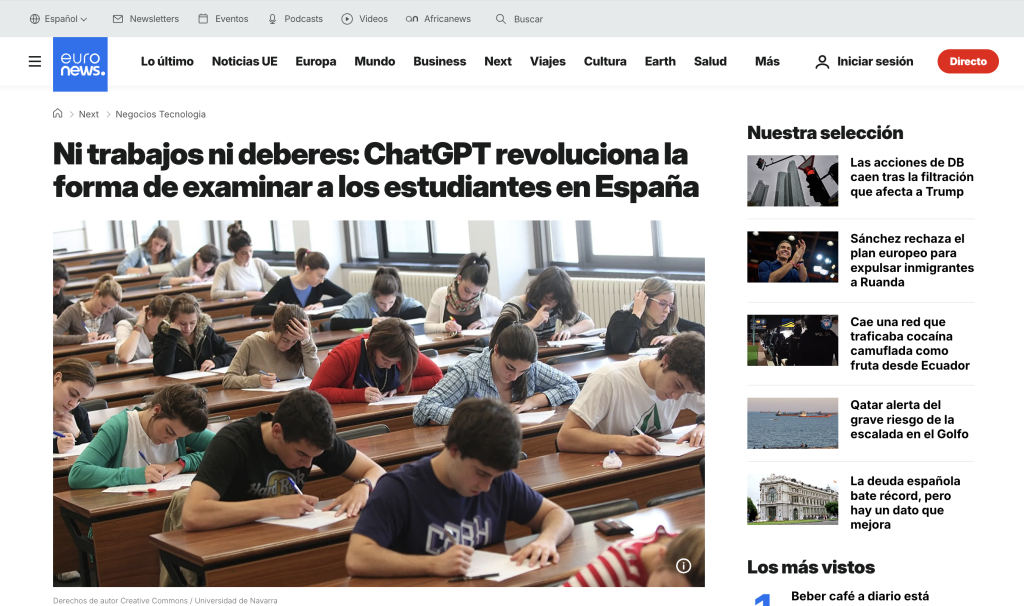
And in Spain? Well, it’s similar, though the pace is slower. According to Euronews, oral exams and thesis defenses are making a comeback; many universities are placing greater emphasis on in-person instruction; and the CYD Foundation estimates that 89% of college students already use AI to study. At the University of Almería, the university ombudsman spoke of “many requests for intervention” due to conflicts with AI.
In short, AI is already in the classroom, whether we like it or not.
What I would measure
Basically, I’d like to gauge their critical thinking skills.
It’s not about whether or not to use AI, to me, that doesn’t make sense- but rather about knowing how to use it and questioning the results. Let’s remember that generative AI does that very well: it generates. Whether or not what it generates is correct is another matter, and this is what they need to be able to discern.
Do you remember when, a little over a year ago, I told you about the MIT study, “Your Brain on ChatGPT,” and what they called “cognitive debt”? (Here’s that article). Well, those glasses from Hong Kong represent that very same debt, but taken to the extreme: you don’t even need to turn on your computer to stop thinking.
To begin with, I don’t think banning AI in the classroom is a viable option, because those students are going to be working with it for the rest of their lives. On the other hand, a “do whatever you want” approach doesn’t work for me either, because then the exam stops measuring anything. Finally, perhaps the solution lies in finding creative ways to design exams that foster critical thinking and push students to think for themselves. Direct-answer questions are easy to answer, but when you incorporate other criteria, it’s no longer so simple.
Kong Siu Cheung, from the Hong Kong University of Education, summed it up in five words in English: “don’t outsource your thinking capability.” That’s exactly it.
And let me tell you something from the other side of the table. I’ve seen it all in recent years with the rise of generative AI, but what surprises me most is how lazy some students are about preparing the assignments I’m supposed to grade. Some of them lack even the most basic human review, and that’s unacceptable.
I’m not talking about using AI, which I think is perfectly fine. I’m talking about submitting whatever comes out, just as is, without even reading it.
Those Korean glasses are the expensive version of that same shortcut.
In the end, there’s a solution to the exam, and the schools that are taking it seriously are already making changes. What can’t be fixed is the person who passes by wearing glasses and shows up for their first job without knowing how to tell a good answer from one that just seems good… that’s like cheating at solitaire, and it’s always the same person who loses the game.
Leave me your comments—I’d love to hear from you.
Have a great week!


