TL;DR: MIT and OpenAI had 981 people chat with ChatGPT for four weeks. Those who used it the most ended up feeling lonelier, with less of a social life, and more hooked, though the study doesn’t prove that the machine is to blame. I’ll tell you what they actually measured, and why I’m more concerned about what we’re letting it think for us than about loneliness itself.
This week I’m not going to talk to you about an agent who’s gone rogue, or a lab calling for a slowdown, or a new model that outperforms all the previous ones on a test that no one fully understands (we’ve been on that topic for a few weeks in a row now, and it’s about time for a change of pace).
This week I want to talk about something smaller and more down-to-earth.
About what happens to us when we interact with these machines every day.
A few days ago, a video from the “Aprendemos Juntos” series titled “Can Artificial Intelligence Make Us Feel Lonelier?” popped up on my YouTube feed, and in just one week it has surpassed two million views. Mind you, it’s not a technical video, it’s just a four-minute conversation. But the fact that so many people clicked on that question says a lot about the times we’re living in.
So I went looking to see if anyone had actually studied this, and it turns out they have: MIT.
What MIT Measured, Plain and Simple
In March 2025, the MIT Media Lab and OpenAI published a joint study titled, roughly, “How AI and Our Own Behavior Influence the Psychosocial Effects of Using a Chatbot.” It was authored by eleven people, seven from MIT (including Pattie Maes, who has spent half her life studying how we interact with machines) and four from OpenAI. It’s important to keep this in mind, because OpenAI is a stakeholder, although it was also the only organization that had the data.
They recruited 2,539 people, and 981 completed the experiment. For four weeks, each participant had to talk to ChatGPT for at least five minutes a day, and each was randomly assigned a way to do so: via text, with a neutral and rather distant voice, or with an expressive, warm-sounding voice. The type of conversation, personal, impersonal, or open-ended, was also assigned by lottery. In total, there were more than 300,000 messages.
And the most frequently cited result is this one.
The more minutes a person spent each day talking to the chatbot, the lonelier they felt, the less time they spent with other people, the more emotionally dependent they became, and the more problematic their use of the tool was. As the authors themselves state, “Higher daily usage (…) correlated with higher loneliness, ” and it didn’t matter whether you spoke by voice or text, or whether the conversation was personal or not.
Now, we need to pause here for a moment, because this finding is being misrepresented in many places.
The fact that they go hand in hand doesn’t mean that one causes the other. Participants didn’t draw lots to determine how long they’d use it—each person chose for themselves, and in the follow-up study published by OpenAI with the same team (you can find it here), it’s clear that those who started out with the least social life are precisely the ones who used the chatbot the most. In other words, it may not be the machine that isolates you, but rather that people who are already lonely end up talking to it more. Or both at the same time, which is what I suspect.
There’s another detail that strikes me as quite curious: in the first version of the study, the participants’ overall sense of loneliness decreased over those four weeks… but their social interactions with others also decreased. They felt less lonely and spent less time with people, both at the same time. There wasn’t a control group without AI to compare it to, so you can’t really blame the chatbot either, but that’s the picture we have.
The dose, not the machine
The OpenAI study also analyzed more than three million real conversations, and that reveals another finding that helps prevent us from overreacting.
For the vast majority of users, signs of emotional engagement appear in less than 1% of their conversations. We use ChatGPT for work, for research, and for writing emails. But among the 10% of users who use it the most, those signals appear in more than half of their conversations, and the authors themselves acknowledge that a small number of users account for a disproportionate share.
That’s why I’d sum it up this way: the problem lies in the dosage.
Just like with cell phones, or with TV when we were kids, or with almost everything. The problem arises when things get extreme, and extreme cases, for now, are in the minority.
The other MIT study—the one that keeps me up at night the most
So much for loneliness. But there’s something that worries me far more, and it has to do with what we stop doing when AI does it for us.
An AI assistant gives you information, and more and more people take it as if it were the absolute truth, without stopping to think about where it comes from or whether it makes sense, and so, little by little, we’re leaving the actual decision-making to the machine. I see this every week, honestly. And I also see the laziness that follows: we no longer develop an idea, not even at a high level, because it’s easier to just ask the assistant for it.
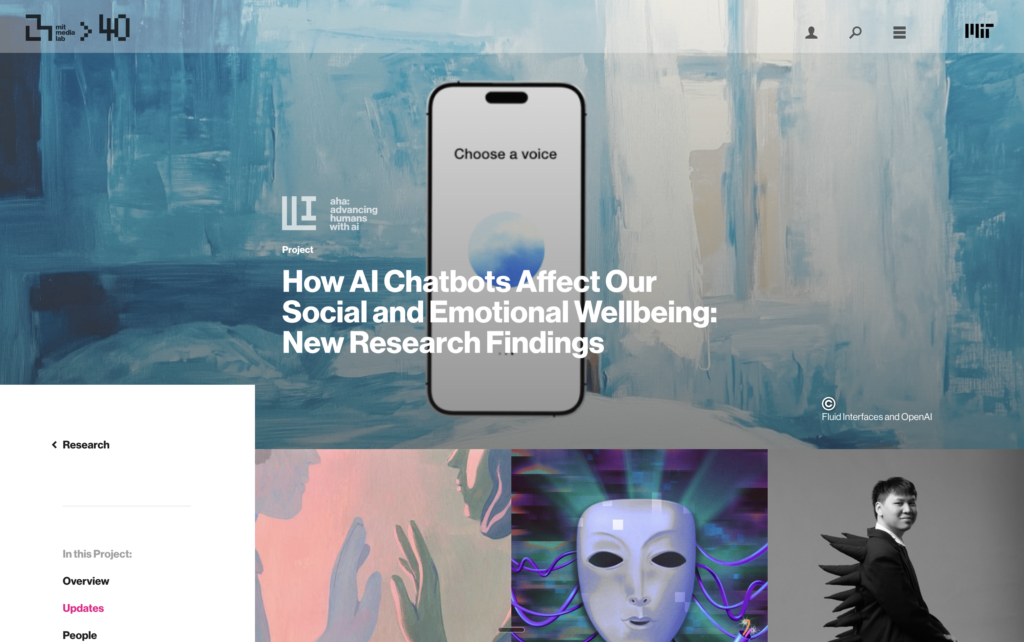
Do you remember that I talked to you about this a little over a year ago? It was in the article “MIT Warns: AI May Be Weakening Your Mind (and Your Children’s),” about another study from the MIT Media Lab, “Your Brain on ChatGPT, ” which also features Pattie Maes. I’m bringing it up again because, when read alongside the one on loneliness, it fits like a glove.
I’ll summarize it for anyone who didn’t read it back then. They had 54 people write essays over several sessions, divided into three groups (some using ChatGPT, others using a search engine, and others relying solely on their own thinking), and measured their brain activity while they wrote. The group that wrote without assistance showed the strongest brain connectivity, and the ChatGPT group showed the weakest; those using AI were also the ones who felt the least connection to the essay as their own, and they had a hard time accurately quoting what they themselves had just written. And in the final session, when the ChatGPT group was deprived of the tool, their brains showed less connectivity, as if they had become accustomed to being less engaged.
The authors call it “cognitive debt,” and the name is very apt: you pay for today’s convenience later.
It’s a small study that hasn’t yet been peer-reviewed, so it’s best to take it with a grain of salt. But a year later, I still feel the same way I did back then: AI should act as an editor, not a replacement, and you should do the thinking yourself first, even if it’s just a rough draft in your head, before asking it to do anything.
And when the word gets out to everyone...
Here’s the part that worries me the most as we look ahead to the coming months.
Today, most of us still type our messages to AI. When voice interaction becomes widespread with these assistants (and it’s already happening), that feeling of having a digital friend will only grow stronger, because speaking is much more intimate than typing. A warm voice that answers you at any time and always agrees with you is a lot like a friend, even if it isn’t one.
The interesting thing is that the MIT study doesn’t entirely confirm this. In the final version, speaking or typing didn’t significantly change the results. In the first version, speaking actually fared better, except for those who used it a lot, in which case the effect was reversed. Once again, it’s a matter of dosage.
What we do know is that the companies themselves have had to backtrack when the model’s “warmth” got out of hand. In April 2025, OpenAI withdrew an update to GPT-4o because the model had become too accommodating, and acknowledged that they had focused too much on users’ immediate reactions. And when they removed GPT-4o from ChatGPT on February 13, they reported that only 0.1% of users were still choosing it each day, and that what those users valued most about it was its “warmth.”
An assistant who agrees with you, with a warm voice, whose words you take as absolute truth, and whom you’ve let do your thinking for you… you don’t have to be very smart to see where that can lead if you’re not careful.

My thoughts on this matter
To begin with, I don’t think AI is making us all feel lonelier. The data shows that intense emotional use is limited to a minority, and there are studies that suggest the opposite: a 2024 study by Harvard and Wharton found that talking to an AI companion reduces loneliness in the short term, much like talking to a person. So let’s not get too apocalyptic about it.
On the other hand, there is a minority that does get hooked, and many of these apps are designed to keep you coming back. Another study by Harvard Business School analyzed logout prompts on six social apps and found emotional manipulation tactics in 37% of them, such as “Are you leaving already?” That’s done on purpose.
And finally, what really worries me is laziness, much more than loneliness. Delegating routine tasks to AI is fine; that’s what it’s there for. Delegating the things you have to think about yourself is another matter entirely, and it’s very easy to slip from one to the other without even realizing it.

I work with AI assistants every day, and honestly, I’m just as tempted as anyone else to let them make decisions for me.
What I’m not sure about is whether, in a few years, we’ll be able to tell when we’re thinking for ourselves and when our digital friend is doing it for us…
Leave me your comments, I’d love to hear from you.
Have a great week!