Perplexity has just launched Model Council, a feature that runs your question in parallel on three boundary models and synthesizes the answer. Gimmick or the real future of enterprise AI?
This week I wanted to tell you about something that I have been thinking about for days, because it touches on the way in which companies will consume AI from now on. And the funny thing is that the news is from February, but the movement behind it is just starting to get the hang of it.
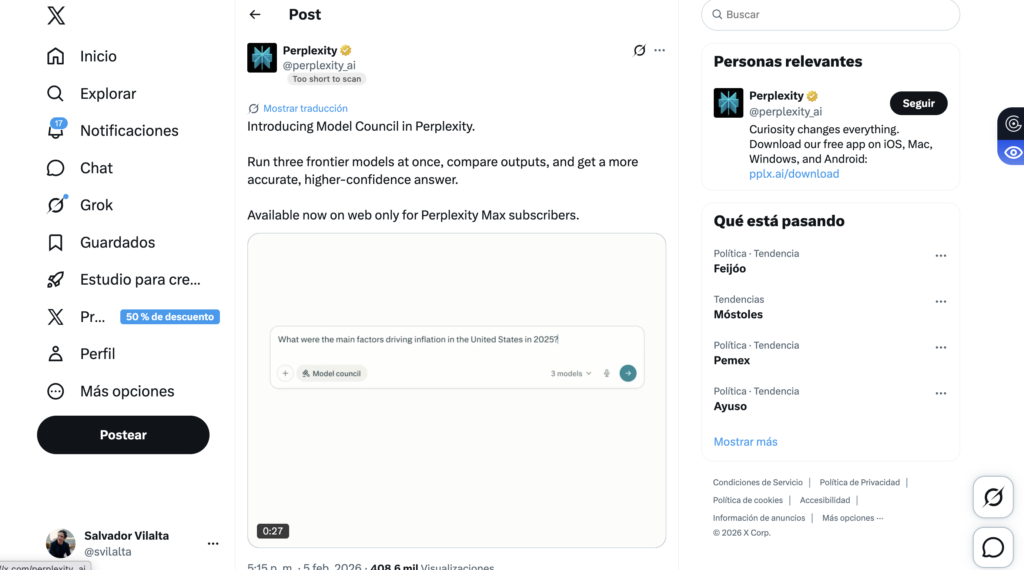
The idea, a priori, sounds simple: instead of choosing an AI model to ask a question, you send that question to three models at once (Anthropic’s Claude Opus 4.6, OpenAI’s GPT-5.2 and Google’s Gemini 3.1 Pro) and a fourth model is in charge of reading the three answers, crossing them, pointing out where the three agree, where they contradict and what each one contributes that the others do not. The end result is a single synthesized response, but with the full map of the debate visible underneath.
It sounds like something out of a science fiction movie. But it’s not. It’s what any Perplexity Max subscriber can already do for $200 a month (or $2,000 a year if you go all-in), and in the Enterprise Max version for companies. For now, only from the web, the mobile app is coming in the next few weeks.
The idea that no one had dared to implement
Until now, the debate in the industry has been binary: pick a single model and stick with it.OpenAI for some things, Anthropic for others, Google for multimodal…. Each company set up its own internal routing architecture, and each user manually tested the same question in three different interfaces to see which one convinced them the most. I’ve done it, you’ve done it, all of us who work with Frontier AI have done it.
What Perplexity proposes is something different: to make this process native and automated, in other words, to make”second opinion” part of the product instead of a handmade habit of the user. In other words, to make the “second opinion” part of the product rather than a handmade habit for the user, remember when we talked a few weeks ago about Microsoft’s humanist manifesto (here is an article about it). Well, this goes in the same direction, but in a different way; instead of proposing a “third philosophy” of AI, Perplexity assumes that no model is the best in everything and builds on top of that reality.
How it works inside
When you activate Model Council in the Perplexity interface, your question is sent simultaneously to the three frontier models I mentioned. Each one answers on its own, without seeing what the others say. Then a synthesizer model comes into play, which checks the three outputs and does three things.
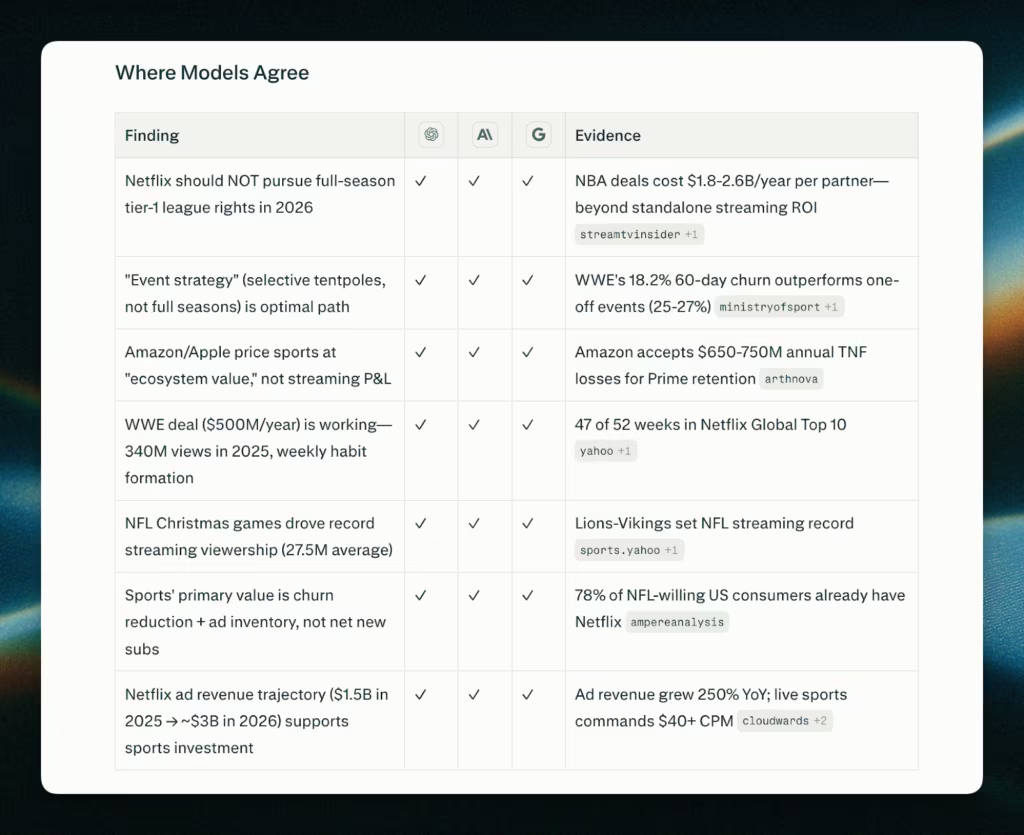
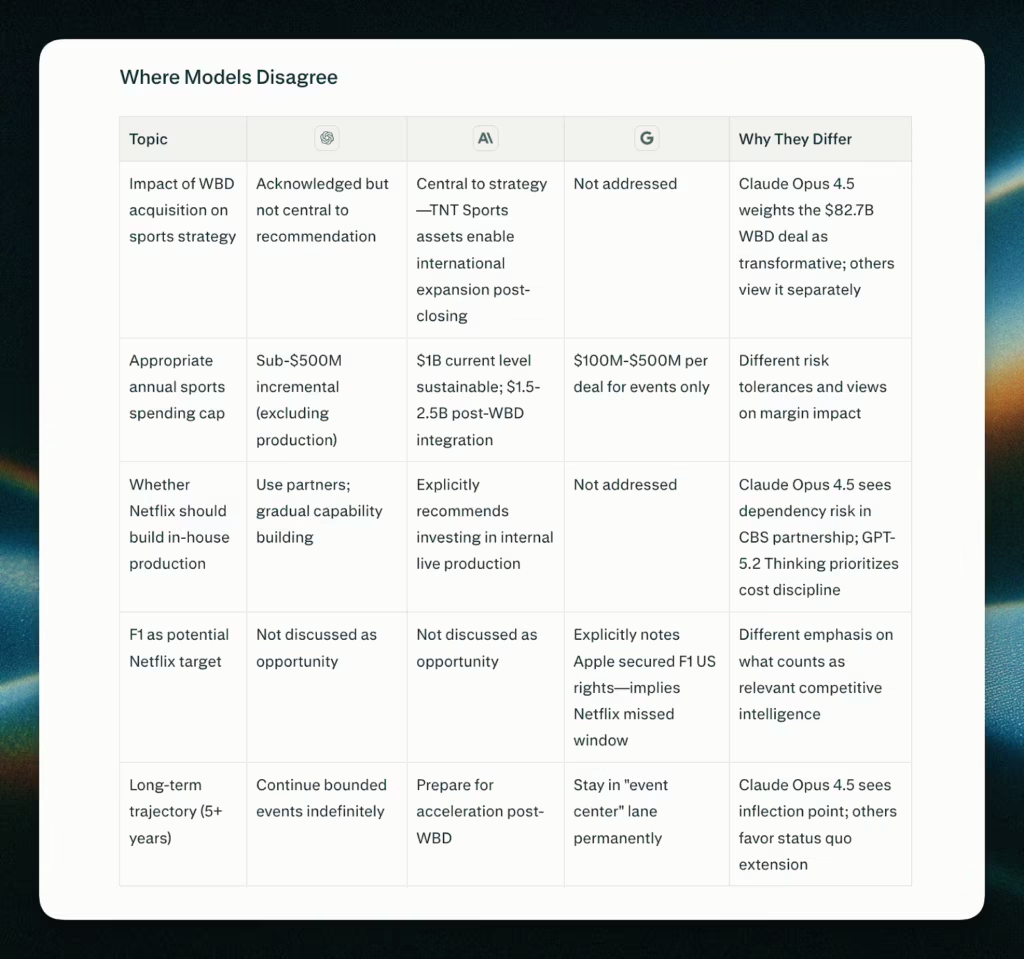
First, it consolidates what all three agree on; that gives you a core response with high confidence. Second, it explicitly states where they disagree and with what nuances; that forces you to look where you didn’t look before. And third, it rescues the unique contributions of each model, those things that only one of the three has mentioned and that are probably the most interesting of all.
What you have at the end is not an answer, but a deliberation. And deliberations, unless you are very optimistic, are usually much better than individual opinions.
What it is really good for
Perplexity sells it for investment research, complex decisions, creative brainstorming and verification. But if you ask me, where this changes the rules is in two very specific scenarios.
On the one hand, any business decision carries a cost of being wrong. A market analysis, a contract review, a strategic evaluation of a competitor. Until now, your only insurance was your own judgment over a model’s answer. With Model Council, you have the judgment of three systems built with different philosophies, trained on different data, and optimized for different objectives. It doesn’t eliminate error, but it reduces the model-specific bias. That’s no small thing.
On the other hand, data verification. In jobs where misquoting data costs you credibility (journalism, consulting, financial advice), the fact that the three models converge on the same figure gives you a sign of reliability that consulting only one does not give you. And if they diverge, even better, you know that you have to investigate before publishing anything.
Perplexity does not stand still
The curious thing is that Model Council does not arrive alone. Just 20 days later, on February 25, Perplexity announced Perplexity Computer, an autonomous cloud-based agent that coordinates up to 19 models to handle multi-step workflows. The company’s message is becoming quite clear: they don’t want to be “another chatbot”; they want to be the orchestration layer on top of all the models in the market.
And in parallel, since March, its Comet browser is available for free on iOS, Android, Windows and Mac, integrating that same multi-model logic into the browsing experience. So, if OpenAI and Anthropic are playing at being “the model”, Perplexity is playing at being “the one who decides which model to use at any given moment”. Different position, different bet.
The underlying trend (which is what is really important)
If you look beyond the concrete product and at the market, Model Council is not an isolated invention; it is the logical consequence of something that has been quietly simmering for months. IDC published in its 2026 AI FutureScape that by 2028, 70% of leading AI companies will use multi-model architectures with dynamic routing across different vendors. And the economic calculus points in the same direction: according to recent analysis, organizations that use a single LLM for everything pay 45% to 85% more than those that use intelligent routing among specialized models.
Translated into English, if your AI strategy is “we’ve hired ChatGPT Enterprise and that’s it”, you’re leaving money and quality on the table. Because no one model is the best at everything. Claude shines in deep reasoning and dense context analysis; GPT dominates code and structured generation tasks; Gemini is stronger in native multimodality; and the open source models (Llama, Mistral, DeepSeek) are unbeatable in cost per high volume and simple tasks. The question is no longer “which model do I choose”, it is “how do I orchestrate between all of them”.
My personal reading
After thinking about it for a few days, my reading goes in three directions.
The first is that the Model Council is an important step but not the final destination, as it remains closely tied to the individual user. It’s fine for an analyst, a consultant or a manager making spontaneous decisions, but for a company that needs to orchestrate thousands of queries a day between different departments, Perplexity’s version is still too manual. What comes next are corporate orchestration platforms (some are already emerging) that integrate this pattern into companies’ actual workflows.
The second is that this marks the definitive end of the “single winning model” narrative. For two years, they have been selling us that there would be a single model that would take it all, the ultimate model, the AGI that would reign over the others. And it turns out that the future looks just the opposite, an ecosystem of specialized models where the value is no longer in having the best one, but in knowing how to use several at the same time. More parliament and less monarchy, so to speak.
And the third, which to me is what’s really relevant if you’re in the enterprise world, is that the teams that are choosing “one AI vendor” today for the next five years are probably asking the wrong question. The right question is not “which model do I hire”, it’s“which orchestration architecture do I ride to consume all the models in the market based on the use case”.
If you are a manager or CEO, keep an eye on this move, as it will change the way you are going to buy AI from now on. In the next budget cycle, when your CTO says “let’s close with X vendor for everything,” it’s just as good an idea to stop him and ask what he has planned for the other two.
If you are a consultant or analyst, Model Council is a tool worth trying this week. Two hundred dollars a month sounds like a lot, but if it saves you just one analysis mistake on a large client, you’ve more than paid for it. He who doesn’t run, flies.
And if you’re simply interested in AI, keep this moment in your head, because it’s quite possible that February 2026 will go down in history as the month when the industry stopped fighting over “which model is best” and started fighting over “how do we orchestrate multiple models.”
How about you? Do you think consulting three models at once gives you better answers, or rather generates more noise than you already have? Leave me your comments, I’d love to read them.
Have a good week!
SOURCES OF INTEREST:
- Perplexity – “Introducing Model Council” (5 February 2026)
- Perplexity Help Center – “What is Model Council?
- AI CERTs News – “Perplexity’s Model Council Redefines Multi-Model Validation”. (February 2026)
- Gend – “Perplexity Model Council: Compare AI Answers Side-by-Side”.
- ResultSense – “Perplexity Model Council Queries Multiple AI Models at Once.” (10 February 2026)
- Beam.ai – “The 19-Model Problem: Enterprise Multi-Model Orchestration”.
- VentureBeat – “Four AI research trends enterprise teams should watch in 2026”.
- Ignitho – “Enterprise AI Orchestration in 2026”.
- Neuriflux – “Perplexity AI Review 2026: Comet Browser, Model Council”.