


TL;DR: I went to MIT to ask a professor about the governance of AI agents, and he ended up telling me not to worry too much about the answers. Then he did a calculation that I haven’t been able to get out of my head for three weeks. I’m sharing it with you because I think it touches on the exact area where the competitive advantage lies.
Thirty thousand days.
That’s it, if things go really well. Eighty-two years, give or take. Do the math yourselves—it’s quite an eye-opener: I did it on the flight back, and it left me with a weird look on my face for quite a while.
But let me set the scene for you, because the number itself isn’t what’s interesting. What’s interesting is where it comes from.
The office, the tape recorder, and the question that wasn't
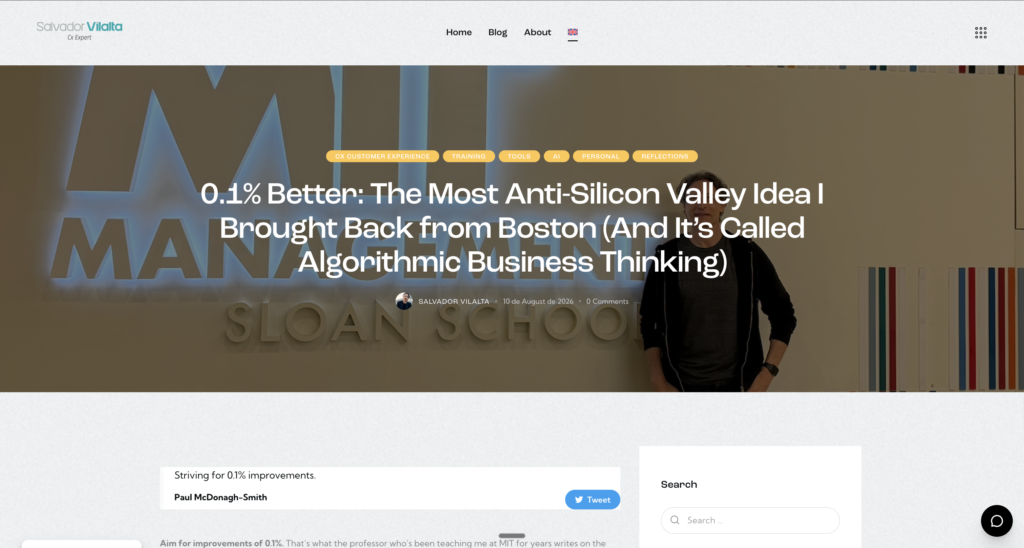
Late July, MIT Sloan, Building E62. I’m sitting across from Paul McDonagh-Smith, with a recorder on the table and a script I’d been preparing for weeks. It’s the first interview I’m recording for the channel, and in English, no less—so you can imagine how nervous I was.
That week, we’d been working on Agentic AI in class. And we’d done a simulation that really shook me up: an agent makes a decision on its own and lands the company in a real financial and reputational mess. So I asked him what had been on his mind since the exercise: when an agent makes a promise on behalf of your company, whose promise is it?
And instead of answering me, he apologized seriously. He apologized for how intense the week had been.
Then he said something I didn’t expect: that at MIT, what they do, above all, is ask questions. That asking the right questions is the key to future competitive advantage. And that everyone leaves there every week with more questions than they had when they started. “Faculty included,” he emphasized, which I found amusing.
I tell him that it’s exactly the same for me that I leave with more questions than before and that’s when he drops this line:
“I wouldn’t worry too much about the answers.”
An MIT professor. In 2026, when the entire industry we work in is selling exactly the opposite: faster, cheaper answers on an industrial scale.
What comes next that’s what really matters
Because it doesn’t stop there, of course. The advice he gives next is far more practical than I expected: take two steps back from the questions you’re working on today, and check whether those questions are truly the best definition of the problem, or if there’s another, bigger, and better problem you should be tackling.
Read that again I’ve read it a few times myself.
He doesn’t say “work harder.” He doesn’t say “use better tools.” He says: maybe the problem you’re solving isn’t the problem.
And that struck me at a specific moment, I’m telling you this because it’s relevant. I’ve spent an entire year optimizing things: processes, tools, workflows, ways of working. And at no point during that year not even once did I stop to ask myself if the process I was optimizing was actually the one that needed optimizing. Honestly, I think it’s a pretty common mistake, and I don’t think I’m the only one who makes it.
What’s more, I think AI makes it worse because when solving problems is cheap, you solve more of them, and when you solve more of them, you stop to consider less often whether it was worth solving them.
And then the bill came
This is where the thirty thousand days come in. Here’s what he said, almost word for word:
Let’s remember that if things go really well on this planet, we’ll probably have about 30,000 days.And when we’re at 28,000, 29,000, or whatever the number may be, sitting in a sunny harbor on our boat with a martini in hand, and we look back over our shoulders at what we’ve done… I hope we can all say with confidence that we went after the biggest and best questions.
And that’s where it ends. And it ties directly into responsibility, which is the other thread that obsesses him: that those of us lucky enough to be close to this technology—even in a very small way have a real responsibility regarding how it’s applied.
Do the math, too seriously. It’s an uncomfortable but highly recommended exercise. I left there with two numbers in my head: the ones I’ve already used up and the ones left if things go reasonably well. And with a question I didn’t expect to bring back from Boston, because I’d gone there to learn from agents.

The Promise That No One Is Auditing
Let’s get down to the practical side of things, otherwise this is going to go off on a tangent.
All of this technology, absolutely all of it, is sold with the same underlying promise: it’s going to give you back time. It automates repetitive tasks, lightens the load, and frees up hours. The numbers presented at committee meetings always point in that direction: how much is saved, how much is sped up, how many hours are recovered.
And here’s the catch which I’ve been mulling over for weeks: we measure in great detail the time that’s freed up, but we measure absolutely nothing about how that freed-up time is spent.
And do you know what that time is being spent on in most places? On producing more. On feeding those hours back into the machine.
That’s not saving time, it’s just shifting the work around.
Let’s focus on this because I think it’s the most important point in the article: if the result of automating your week is that you’re now doing twice as many equally irrelevant things, you haven’t gained anything; you’ve sped things up—which is something entirely different—and on top of that, it’s just as exhausting.
Why this ties in with the 0.1% I told you about
Those of you who read the previous article in this series will remember the idea of 0.1%: improving just a little bit every day that philosophy, so unlike anything from Silicon Valley, that I brought back from Boston and that runs counter to the whole narrative of disruptive change.
Well, this is the other side of the same coin, and without this side, the first one is useless. The 0.1% is themethod. The question determines what you apply the method to.
And being 0.1% better every day in the wrong direction still amounts, after a year, to going in the wrong direction. You’ll just have gone farther down the wrong path.
That’s why I think these two articles should be read together, even though I’ve separated them by two weeks.
My thoughts on this matter
To start with—and I say this with some hesitation because I’ve been making a living doing the opposite for years I think we’re vastly overestimating our ability to answer and underestimating our ability to ask questions. Answers have become a commodity in roughly eighteen months.
Anyone with twenty euros a month has access to a system that provides better answers than most experts did five years ago. What hasn’t become a commodity, and I don’t think it will anytime soon is knowing what’s worth asking in your specific context, with your data, your customers, and your limitations.
On the other hand, and this really does worry me, there’s a perverse incentive at play: the cheaper it is to execute, the less profitable it seems to stop and think. Stopping doesn’t produce anything measurable that day. It doesn’t show up on any dashboard; there’s no metric that rewards someone who spent a morning verifying that the project the entire team is working on is the right one.
And finally, something I took away from the entire conversation that I hadn’t expected: the part that remains ours isn’t the most lucid one; it isn’t coming up with the brilliant idea. It’s much more tedious to take two steps back and check whether the question is the right one. That can’t be delegated, just as he says that an agent’s responsibility can’t be delegated.
Maybe… and here I’m just speculating, maybe in a few years, the defining skill of a manager won’t be deciding quickly, but deciding what to decide. Which sounds similar but is actually completely different.

The full interview is posted on the channel, in English and divided into chapters, in case you’d rather hear it from him than have me recount it: the entire conversation with Paul McDonagh-Smith. The part about the thirty thousand days comes up in the section on agents, around the twenty-minute mark, and lasts less than a minute. It’s one of those things you might miss if you’re in a hurry—which, now that I think about it, is pretty consistent with everything else.
I haven’t quite decided yet what to do with the account. I know something about it has changed, but I couldn’t tell you exactly what…
What about you? If you had to tell me right now what’s the important question you haven’t asked yourself, would you know what it is? Leave me your comments; I’d love to hear from you.
Have a good week!


