Where should you be if you want to be at the center of the future? If you’re in artificial intelligence or simply passionate about its evolution, this question is key. For years, everyone looked to Silicon Valley. But the map has changed. Today, there are new innovation hubs emerging with a bang, and one of the most surprising (and ambitious) is Dubai.
In this content, I’m going to explore which countries and cities are leading the game in AI and, above all, why Dubai has broken into the top 5 worldwide… even surpassing San Francisco in some rankings. Spoiler: it ‘s no coincidence.
The new global AI map
When we talk about technology hubs, we usually think of the United States, China or the United Kingdom. And yes, they are still leaders in investment, talent, and innovation. But the regulatory environment is starting to make a very significant difference.
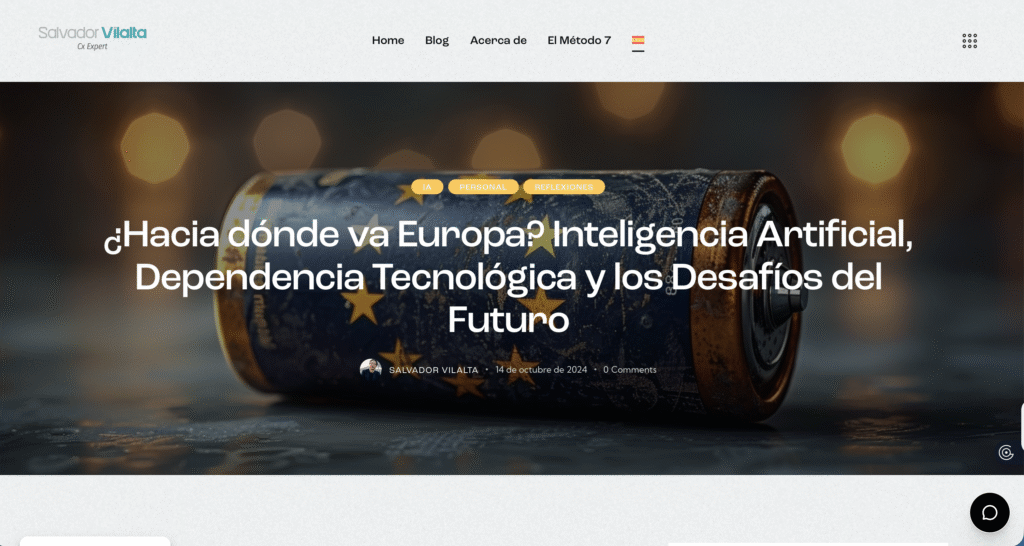
Europe has basically opted for regulation and red tape instead of innovation, with laws such as the AI Act that protect rights… but, in my opinion, they are a burden, draining talent from areas that are more “friendly” to this technology. I wrote about this some time ago, asking myself: “Where is Europe heading? Artificial Intelligence, Technological Dependence and the Challenges of the Future”.
- USA maintains a more flexible approach, without strong national regulation, allowing for faster progress. The recent entry of the Trump Administration has boosted its geopolitical position in this area.
- India, Singapore, Israel, and other Asian countries are seeking a balance: lots of investment, incentives for startups, and light regulation. They host one of the most important AI events in the world, SuperAI Singapore. This 2025 brought together more than 7,000 experts from around the world, positioning the city as the Asian center of innovation in artificial intelligence, with debates and presentations on advances in robotics, health, and finance, as well as startup competitions and hackathons focused on real applications of AI.
The United Arab Emirates, led by Dubai, has chosen the path of audacity: zero barriers, maximum ambition.
Dubai: from desert to AI living lab
A government that leads by example
Dubai does not wait for the private sector to move the wheel. It does it from the top: every public institution has its own Chief AI Officer. It is training
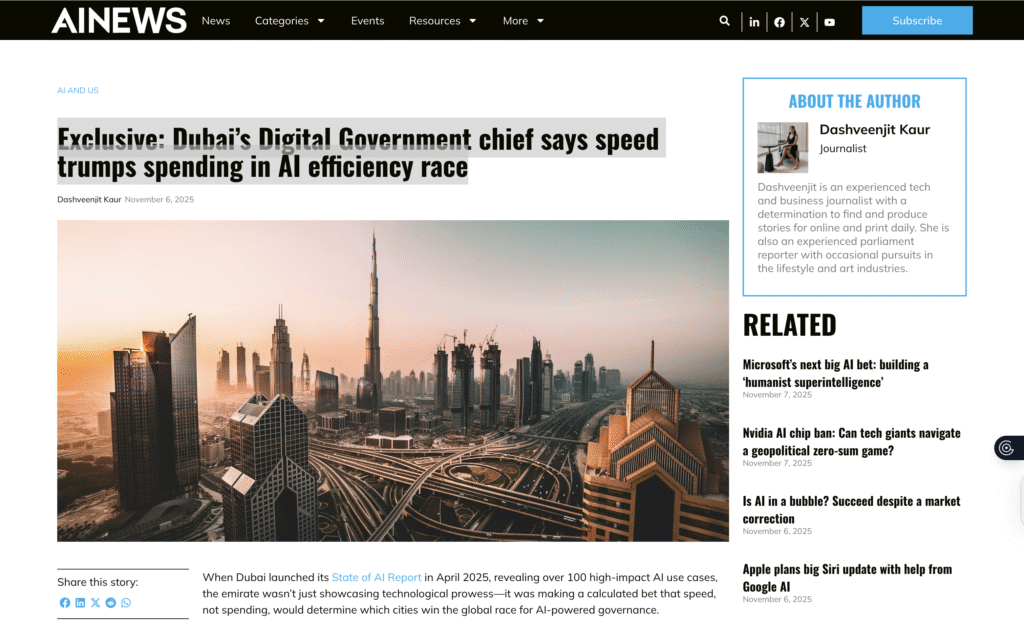
In addition, Dubai is building a unique AI-driven governance model, led by Matar Al Hemeiri, CEO of the Digital Dubai Government Establishment. Unlike Abu Dhabi’s more investment-driven approach, Dubai puts the focus on speed of implementation and ethical integration from day one. A tangible example is DubaiAI, a virtual assistant that already manages more than 180 public services, and mass adoption: 96% of government entities already use AI solutions.
This deployment spans healthcare, urban planning, energy, and more. All backed by a
Investment without fear
2.7 billion fund to accelerate startups.
Golden visas to attract tech talent from around the world.
Advanced data centers, 5G infrastructure and supercomputers ready to train AI models.
Universities, companies and startups aligned
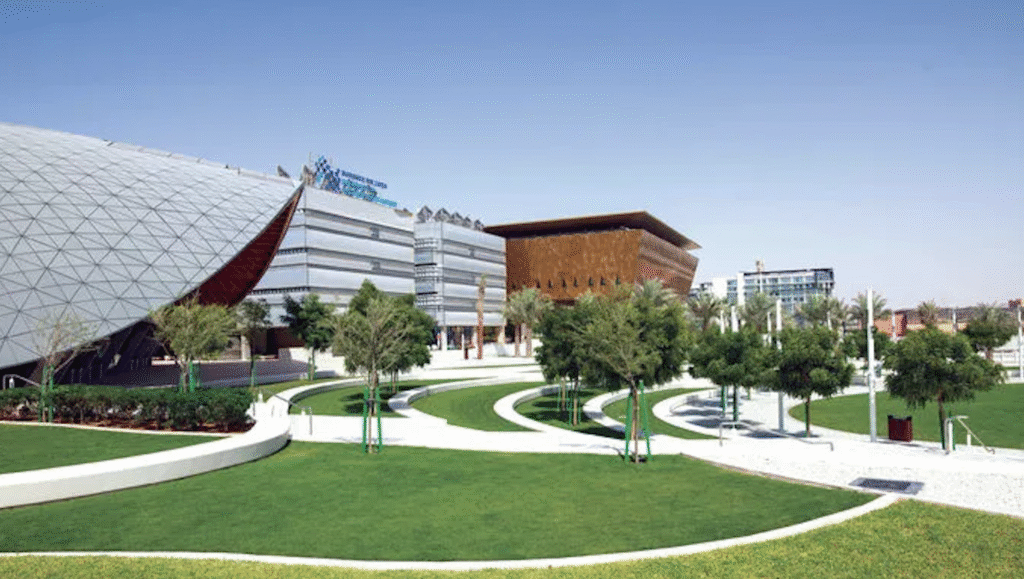
The MBZUAI (Mohamed bin Zayed University of AI) in Abu Dhabi is the world’s first dedicated exclusively to this discipline. G42, the local tech giant, already collaborates with Microsoft, OpenAI, and Nvidia. And more than 400 startups have chosen Dubai as their base of operations.
Minimum regulation, maximum adoption
There are no obstacles here. On the contrary, autonomous vehicle tests are approved, robots are integrated into the police force, and chatbots are used for government procedures. Dubai acts as a real sandbox in which to test, improve, and scale.
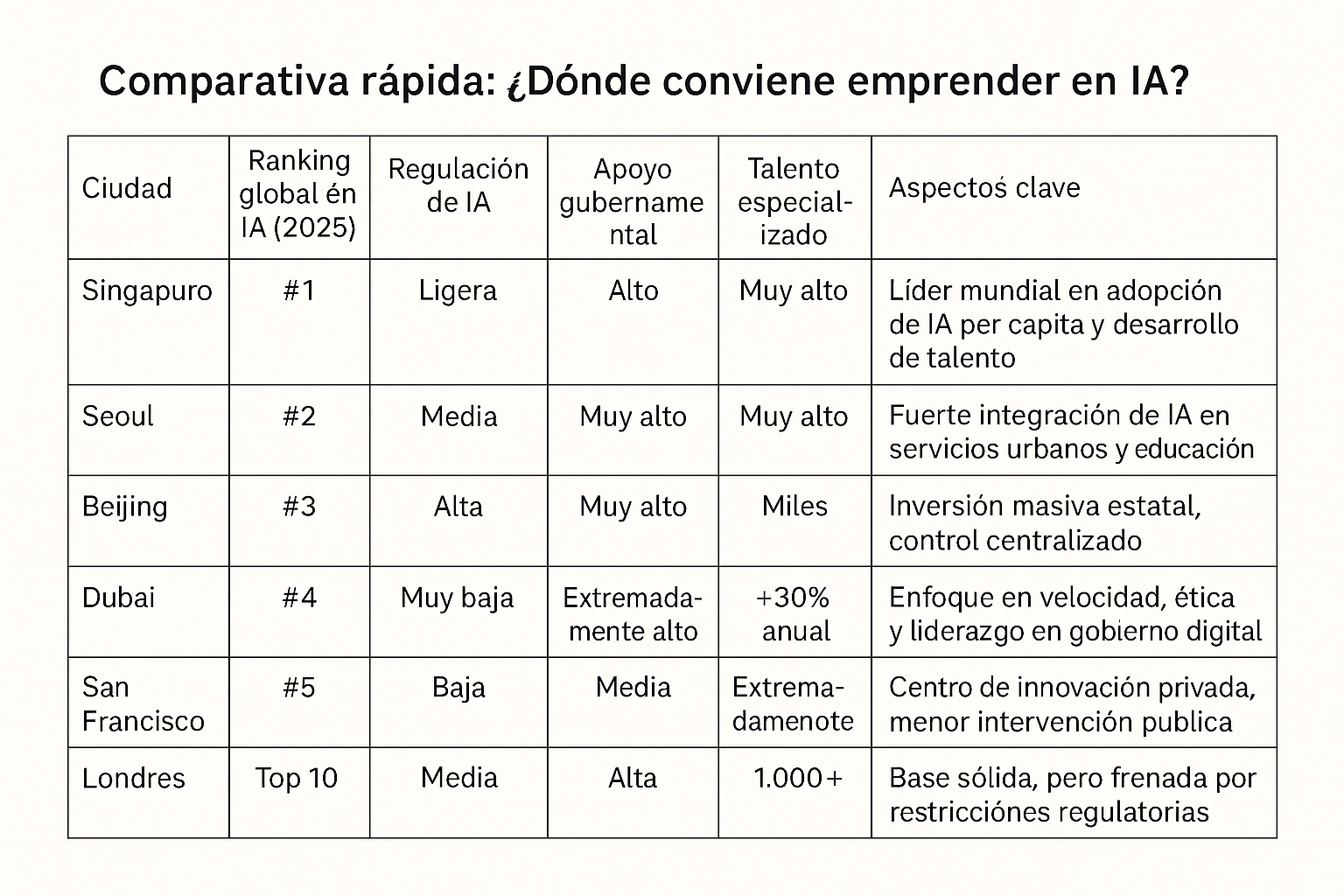
Quick comparison: Where to start a business in AI?
Europe: good intentions, uncertain results
Europe wanted to be a pioneer in the ethical governance of AI. And while it is laudable to want to protect rights and minimize risks, overregulation is starting to take its toll. The EU AI Law, with its risk-based approach, requires complex assessments, certifications, and bureaucratic processes even for small startups. The result: many projects slow down or move directly to more permissive environments.
What is worrying is not only the slowness, but also the flight of talent and capital. Engineers, founders, and investors are looking to Dubai, Singapore, or even the US, where the conditions for innovation are “friendlier” and execution speeds differ. If Europe does not soon balance its approach, it risks being a bystander to the revolution it inspired.
I leave you with an interesting video in which Julia Reuss (Central Europe Policy Director at Meta) comments on the EU’s AI Law and overlapping data regulations and how these are holding back innovation and threatening competitiveness.
The United States and China will remain giants. But dynamism, agility, and a hands-on approach are finding homes in places like Dubai. Where once there was desert, today data centers, AI universities, and startups from around the world are flourishing.
Is Dubai the new Silicon Valley? No. It’s something different. It’s a place where artificial intelligence is taken as a country bet, not as a fad.
And if the history of technology teaches us anything, it is that those who dare first, win first.
What do you think? Do you know companies that are looking towards Dubai or Singapore? Do you think Europe will be able to keep pace with these emerging hubs?
Leave me your comments below, I’d love to read them:
Have a good week!