5.55 billion dollars. That’s what Cerebras raised on Wall Street last Wednesday to stand up to the monopoly Jensen Huang has been building over the past five years. And in case there was any doubt, on the first day of trading the shares rose 68%, closing with a valuation of close to $95 billion in a pretty wild day.
It’s not just another IPO. It’s the biggest tech IPO in the U.S. since Uber’s in 2019, and the first time a direct competitor to NVIDIA in AI chips has gone public at a real valuation. Let’s take it in parts, because there are several layers to the story, and honestly, I think some of them are worth stopping to tell.
On the surface, it looks like just another tech IPO. But when you scratch a little, what emerges is the first visible crack in NVIDIA’s wall in the last five years. And that changes everything.
Who is Cerebras and why does it suddenly matter so much?
Cerebras is a company founded in 2015 by Andrew Feldman in Silicon Valley. Feldman, prior to this, had set up and sold to AMD a company called SeaMicro, which was already along the lines of “making infrastructure more efficient than what the big guys offer”. Come on, he’s no newcomer. After Wednesday’s IPO, his personal stake in Cerebras is worth about $3.2 billion. Not bad for someone who had been hearing for ten years that this was “a technical project that would never scale.”
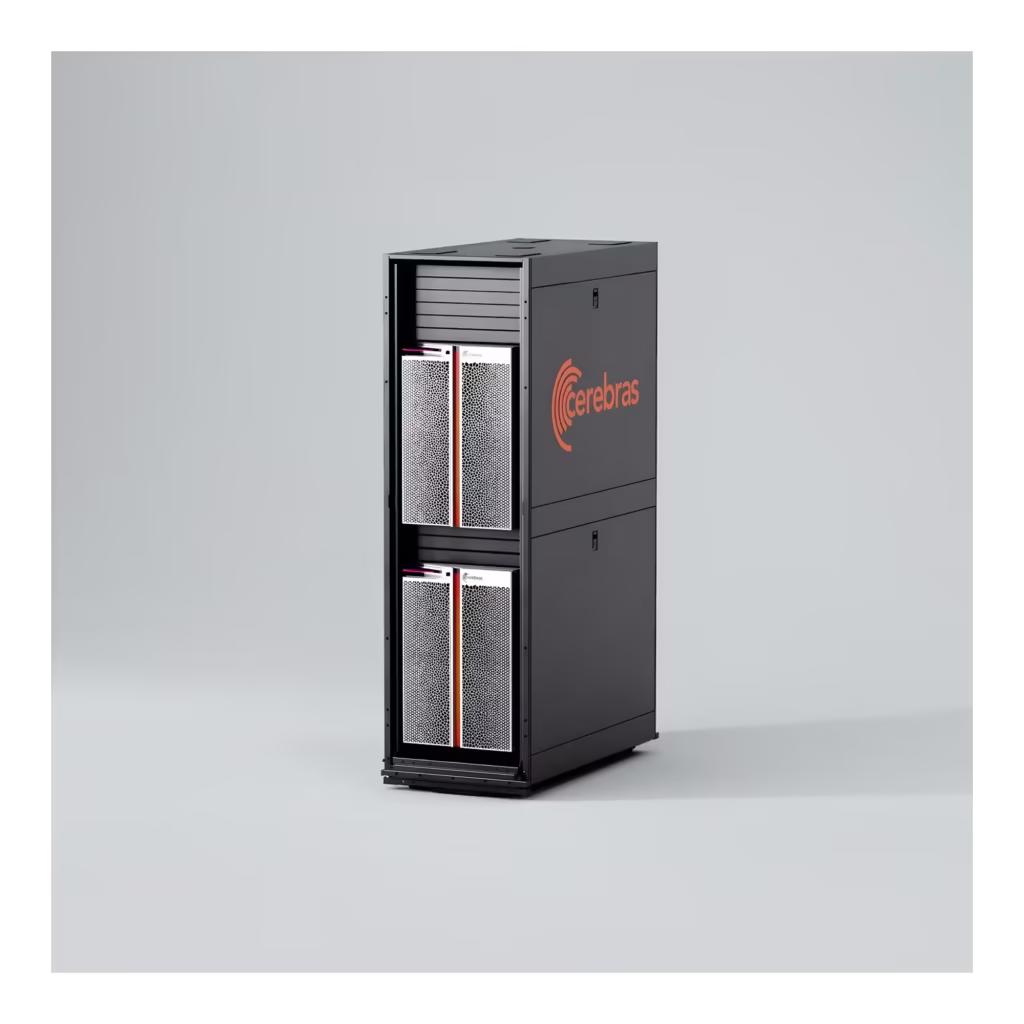
And what exactly does Cerebras manufacture? Well, here comes the interesting part, I promise not to get lost in the technical stuff. They make a chip that is literally the size of a dinner plate. To give you an idea, a traditional NVIDIA chip (an H100 of the kind that drives half the world’s AI right now) is about the size of a large postage stamp. The Cerebras chip, called WSE-3, is 56 times bigger. That’s not a metaphor, that’s the real figure.
And what is that good for? Here’s the key that almost no one gets right. In a system with traditional GPUs, the AI model has to constantly fetch information to an external, off-chip memory. Imagine you have to cook, and every time you need an ingredient, you have to go down to the supermarket around the corner; you’d be cooking pretty slowly. What Cerebras has done is to put all the ingredients directly on the countertop. The result: they claim to generate AI responses 15 to 25 times faster than an equivalent GPU system.
This is called the “memory wall” in the industry, and it has been one of the major bottlenecks in recent years. And solving it this way, with one giant chip instead of many small chips connected to each other, is the bet that Cerebras has been making since day one.
Five years ago, almost the entire industry laughed at the idea. Today, OpenAI is paying for it up front.
The blow that NVIDIA has felt for the first time
In January of this year, OpenAI signed a deal with Cerebras valued at more than $10 billion for 750 megawatts of computing capacity through 2028. 750 megawatts, to give you an idea, is the power consumed by an entire small city. And that was the initial deal. In recent weeks, the commitments between OpenAI and Cerebras have expanded to more than $20 billion, with OpenAI possibly ending up with about 11% of Cerebras’ equity. Yes, you read that right: Sam Altman doesn’t just want to buy chips from Cerebras, he wants to own a chunk of the company.
And it doesn’t stop there. In March, Amazon Web Services announced it would begin deploying Cerebras chips in its own data centers. In other words, the world’s leading cloud provider, historically one of NVIDIA’s biggest customers, has decided to bring the competitor directly in-house.
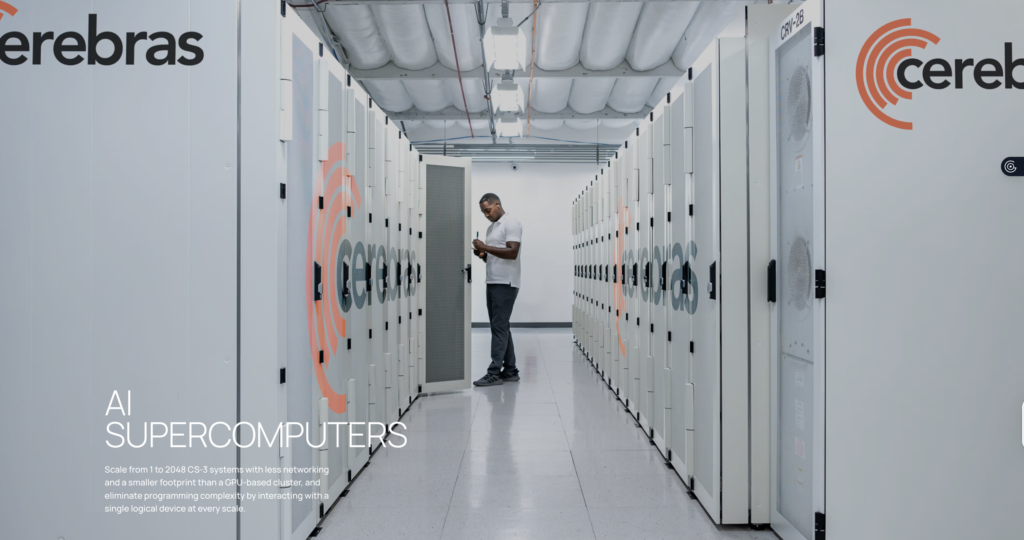
And there’s more: Meta has been using Cerebras for its Llama API since April 2025. Mistral, the European bet, has been using it for Le Chat. Perplexity runs its Sonar model on these chips at 1,200 tokens per second (fast, very fast). G42, the Microsoft-backed Emirati AI giant, signed a framework agreement with Cerebras some time ago. Come on, it’s not a company with a client and a lot of marketing. It’s a company with half of the top tier of global AI in its portfolio, just as it goes public.
(By the way, this fits like a glove with what we were saying a few weeks ago in that article about the three-player AGI race in the West where we said that the real currency of this race was not the models but the compute. Well, look who’s grabbing non-NVIDIA compute).
And if I go back to DeepSeek V4 that we talked about three weeks ago, the pattern repeats itself: we are seeing in real time how all the majors are looking for real alternatives to Jensen Huang’s silicon. On the Chinese side, via Huawei. On the American side, via Cerebras, Groq, AMD, and a handful more. For the first time in a long time, the monopoly is creaking in several places at once.

Jensen Huang's answer (and why it's not trivial).
This is where the story gets quite interesting for those of you who follow this industry.
In December last year, NVIDIA made the biggest deal in its history: it paid $20 billion for Groq, another major competitor in inference chips. The deal was officially sold as a technology licensing agreement and an “acqui-hire” (basically, you buy the company for its equipment). In practice, analysts read it as NVIDIA absorbing the competitor that was squeezing it the most before it got too big.
And in March, NVIDIA announced Groq 3 LPX, the first chip to come out of that acquisition. The promise: combining it with its Vera Rubin system, they could deliver up to 35 times more tokens per watt in real-time inference tasks, compared to their own previous racks.
The figure sounds brutal, but there is certainly one not minor detail: these chips do not start to be delivered until the third quarter of 2026. In other words, Cerebras can continue to capture customers without Huang’s answer being in actual production. And half a year, in this industry, is an eternity.
That’s the crack. It’s not that NVIDIA is going to lose its dominant position tomorrow, far from it. It’s that for the first time in five years it’s becoming clear in real time that there are real alternatives, that those alternatives have top tier customer portfolios, and that Wall Street is willing to put $5.5 billion on the table to bet on it.
What I believe
For starters, that IPO marks a really significant phase shift in the industry. For five years, we’ve talked about NVIDIA as if it were “the only serious option” for doing AI at scale. The 95 billion valuation figure for Brains at the close of the first day says otherwise. It looks like the market is willing to fund alternatives with amounts comparable to those previously reserved only for NVIDIA and its closest satellites.
On the other hand, it is important to note that the watt economy rules, and it rules more and more. What is happening with Cerebras is not a disruption of innovation; it is pure mathematics. When you train or serve an AI model, the cost per query tends to be dominated by the cost of electricity, the cost of the data center, and the cost of the chip running the operation. Any architecture that reduces any of the three components rules in commercial terms, regardless of which company makes it. And Cerebras seems to be winning on one or two of those components right now, depending on the specific type of load.
Also, more importantly, in my opinion: what is happening with OpenAI buying a chunk of Cerebras has very clear parallels with Anthropic’s deal with SpaceX that we talked about last Monday on the blog. The AI giants are no longer content to be customers of their infrastructure; they want to own it, lease it exclusively, or have stakes. It’s a pretty clear sign that the bottleneck has shifted: it’s no longer the quality of the model, it’s the ability to get enough chips to serve it at scale. Whoever controls that bottleneck controls the business.
And if this continues, in the next twelve months, we are going to see more of these types of operations. Big bets, vertical alliances between AI labs and alternative chipmakers, and probably some other similar IPO (AMD on the cloud-AI side, a Chinese one that decides to jump the pond, maybe Groq as a semi-independent spin-off from NVIDIA at some point… we’ll see).
What is clear is that NVIDIA’s empire, for the first time since 2020, has visible cracks. And Wall Street just put numbers to those cracks.
The detail that closes all this
One thing that I find curious and that many analysts are overlooking is the downward correction of the Cerebras stock the day after the IPO. In fact, we saw that on its IPO it went up 68% and then stayed flat for a week. Surely this is a clear sign that the market has calmed down, digested the news, and that the price has stabilized around a reasonable valuation, not around a moment of euphoria.
Does this mean that Cerebras will replace NVIDIA tomorrow? Of course not. NVIDIA turns over about 130 billion a year and Cerebras turns over about 510 million. We are talking about two completely different scales. But as Morgan Stanley analysts said on IPO day, this isn’t about taking NVIDIA’s place. It’s about proving that the AI chip market is not a single-player market but an ecosystem with several legitimate players. And that, for an industry that had been sitting with one name on the table for five years, is a pretty big transformation.
We’ll see how this all evolves in the coming months, no doubt. The big question here is whether Cerebras will be able to keep up its growth momentum when NVIDIA starts delivering Groq 3 LPX in Q3, whether OpenAI actually ends up with that 11% share, and whether the other AI labs start moving in the same direction. If they do, the global AI board is going to change in a really significant way in the next 18 months… and we’ll be there to tell the tale.
How do you see it, is this the first small step in the fall of the NVIDIA monopoly, or a one-off move that will fizzle out as soon as Jensen Huang releases his new chips?
Leave me your comments, I’d love to read them.
Have a good week!
LINKS OF INTEREST
- CNBC – Cerebras pops 68% in Nasdaq debut… $95 billion (14 May 2026)
- TechCrunch – Cerebras raises $5.5B… first huge tech IPO of 2026 (14 May 2026)
- CNBC – Cerebras prices IPO above expected range (13 May 2026)
- The Register – Cerebras’ wafer-scale AI bet delivers blockbuster IPO (15 May 2026)
- Bloomberg – Cerebras CEO Feldman’s Stake Hits $3.2 Billion (14 May 2026)
- TechCrunch – OpenAI signs deal worth $10B for compute from Cerebras (14 Jan 2026)
- DataCenterDynamics – OpenAI signs $10 billion deal with Cerebras, 750MW (15 Jan 2026)
- TECHi – Nvidia’s $20 Billion Groq Deal: What the Acqui-Hire Means
- TSPA Semiconductor – GTC 2026 Outlook: How NVIDIA Is Redefining AI Infrastructure
- Tech Insider – Cerebras IPO: $510M Revenue, $10B OpenAI Deal, $23B Valuation