


Imagine yourself driving your car up a mountain road without guardrails in the most dangerous curves. The speed may be cool, but the risk of something bad happening to you can be very high, even deadly. This is the situation we find ourselves in today in the field of AI: we go at full speed, but if we don’t set limits, an accident is only a matter of time.
This week, I would like to explain to you what AI guardrails are, why they are so necessary (I would say essential), and how they are applied in practice, without impairing the performance of AI language models and AI Agents.
So that you don’t get lost, I will try to be as didactic as possible and give you some real-life examples. Let’s start…
What the hell are guardrails in AI?
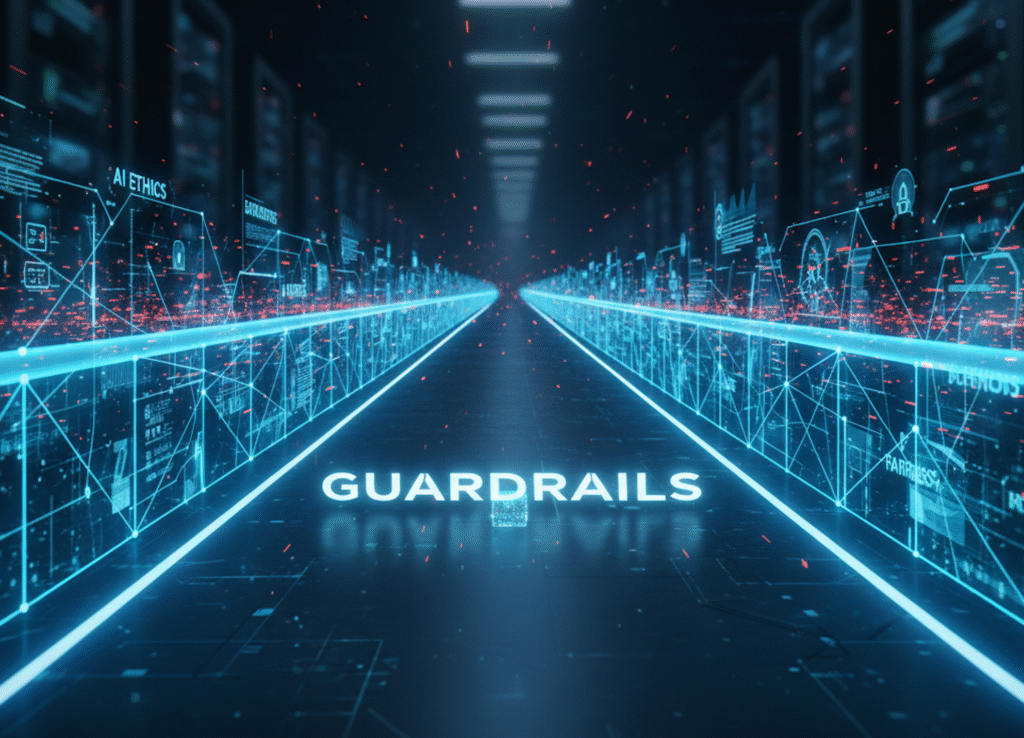
Perhaps the best simile could be that of the protections on the road, the guardrails. They are not there to annoy you on your trip, but to make sure you don’t go over the edge.
In AI, we’re talking about measures (filters, rules, watchdog models…) that prevent systems from doing or saying things they shouldn’t. And we’re not just talking about obvious outrages like insults or illegal content, but any deviation that could jeopardize ethics, security, or even a company’s reputation. There are plenty of real examples: a chatbot that, after being manipulated, sells cars for $1; another that gives recipes for homemade bombs if you give it the right “prompt”.
And the worst thing is that, without barriers, these models are so convinced that they are helping.
Why are they more necessary than ever?
Because AI is no longer limited to answering trivial questions, it now generates texts that seem to be written by humans: it serves customers, advises on health, speaks in a natural voice, and will soon be making business decisions.
Now, mistakes are no longer funny; they are dangerous. For example, if an artificial intelligence gives wrong financial advice or reveals confidential information, the problem is no longer technical: it is legal and reputational. This is why guardrails are not optional; they are literally mandatory.
How are these brakes installed?
Here comes the interesting part. There are several ways to build guardrails, from the most basic to the most sophisticated. I explain it as if we were building an onion of layers of protection:
- Direct filters: the simplest. Prohibited words, sensitive expressions, and numbers that cannot be said (such as cards or accounts). They are applied before or after the template, like a spam filter.
- Semantic control: instead of words, measure the meaning. If your question sounds too much like something violent, sexual or out of context… block. It requires a little more intelligence, but it’s more effective.
- Judge model: a “mini-me” that examines the query and determines whether it is eligible. If it gives the green light, the main model responds. If not, it stops. It’s like having an invisible moderator.
- Internal instructions (prompt engineering): tell the model “hey, you only talk about hotels, and if they ask you anything else, say you can’t help”. Easy to apply, but also easy to mock if not reinforced with more layers.
In practice, they are all combined. Like slices of Swiss cheese: each one has holes, but together they block the passage.
And with voice? Isn't everything more difficult?
Undoubtedly, since voice introduces new challenges: everything happens in real time, you can’t check before it rings, and attacks can come disguised as an urgent tone or fake voice.
Therefore, the gatekeepers in this area must: review the content before converting it into audio; transcribe the input and analyze it as if it were text; detect suspicious emotions or urges; prevent the system from reacting solely to voice pressure; and verify identity (to avoid fraud from voice deepfakes).
A practical example could be a reservation assistant in a restaurant that detects insults, does not cancel reservations out of policy and blocks personal data, such as cards. All that in seconds and without blocking itself. Undoubtedly, magic
Are there tools to implement them?
As you well know, there are tools for almost everything. Some of them:
AWS Bedrock and Azure OpenAI offer preconfigured filters.
NVIDIA NeMo Guardrails: allows you to write dialog rules in your own language (Colang).
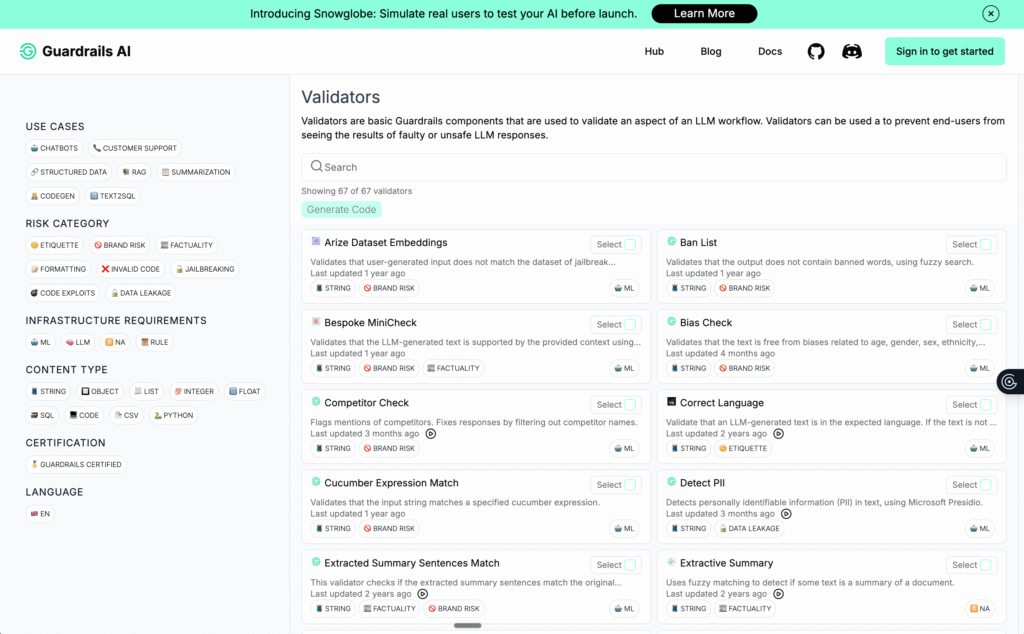
GuardrailsAI: focused on validating and correcting answers before displaying them.
And more and more startups are being born just for this. Because the need is real.
How to tune guardrails?
When we activate the guardrails, we must adjust their thresholds (neither too soft nor too hard), on the other hand customize according to your business (a bank is not the same as an ecommerce), try to break them (as if you were a hacker), listen to the users (and check what the system blocks or lets through), but without driving the model crazy. This is a precision task.
This is like computer security: it is never 100% guaranteed, but if you take measures, it can become increasingly solid.
Guardrails turn powerful AI into useful, safe, and ethical AI. And in a world where AI will be everywhere, from the cell phone to the car to the office to the living room, we need to know that it won’t get out of the way.
So now you know: if you’re thinking of integrating AI into your business, start by defining where your dangerous curves are, and what guardrails you need to put in place. Because innovating without brakes can seem brave… until you crash.
How about you? Are you already putting the brakes on your AI? Have you ever had a chatbot say something weird or out of place? Tell me about it in the comments, I’d love to read about it.
Have a good week!


