


This week we had some very relevant news for breakfast. Apple has just made a very relevant decision, and this time, the move is epoch-making: it has chosen Google Gemini as the default engine for the new Siri and also for its Apple Intelligence strategy.
I have commented in many of my content, in this regard, the uselessness of Siri in its current operation, to the point of disabling it on my devices. But this move is a game changer… and a big one.
This move means that ChatGPT, while still there as a secondary option, is no longer at the center of the equation. If you’re in technology, product, or business, this move should raiseyour eyebrows.
But, let’s get to the point.
Not only does it imply a change of supplier, but also of philosophy.
Apple had been pushing OpenAI and ChatGPT for months. We saw it appear in demos, rumors, and even official presentations, but in the end, the multi-year deal went to Google.
The key is not in the brand, but in what lies beneath it: real capacity, scalability and privacy.
They haven’t bought a chatbot; they have bought an artificial intelligence infrastructure that can keep up with Apple’s pace: millions of users, sky-high expectations, and zero margin for error.
I was not looking for price but for capacity, and that changes everything.
Apple did not sell this as a strategic alliance or partnership agreement, but as a technological capability. In fact, when a company like Apple gets serious about AI, the questions stop being naïve and become very concrete:
- Can this withstand a brutal load without falling over?
- What latency do I have when everyone is asking for the same thing at the same time?
- Can I run it on the device without sending data out?
- Does it fit with my architecture… or does it force me to redo half of my technology stack?
These are real questions from a live product that can’t fail.
Apple only plays if it can be hybrid. And that's a lesson for everyone
Apple’s approach is not “all in the cloud.” It’s hybrid or nothing.
The most sensitive (e.g., personal data) remains on the device. The heavy stuff (such as complex reasoning) is moved to the cloud… your private cloud, under your control, without giving away data.
This, in business terms, translates into a fairly sensible architecture that I talked about in one of my last posts:
Edge for the critical.
Cloud for the complex.
Control for everything.
If your AI strategy is to run everything to the cloud and cross your fingers, this move by Apple should give you pause for thought.

And why Gemini yes and ChatGPT no (as default layer)?
Basically, because Apple is looking for something very important and that is evidence of a deployment at scale.
Gemini is already running on hundreds of millions of Samsung devices, and that counts for a lot, because when you stake your reputation, you don’t choose the best positioned in the benchmarks, but the one you know won’t break your product tomorrow.
And there’s another thing: in long-term agreements, the winner is not the best today, the winner is the one who guarantees a smooth evolution. And that, in a market that changes with extreme speed, is worth gold.
Dependency exists. But it can be managed
Yes, Elon Musk complained that this reinforces Google’s power. And he’s not wrong.
Because when you choose a supplier for your AI, you’re not just buying technology. You’re buying:
Commercial dependence.
Technical dependence.
Strategic dependence.
But Apple is not new to this. It already has a giant relationship with Google for the search engine. And if it has signed this deal, it’s because it believes it can manage that dependency… or that the profit makes up for it.
Apple also has models of its own. And that makes it even more interesting
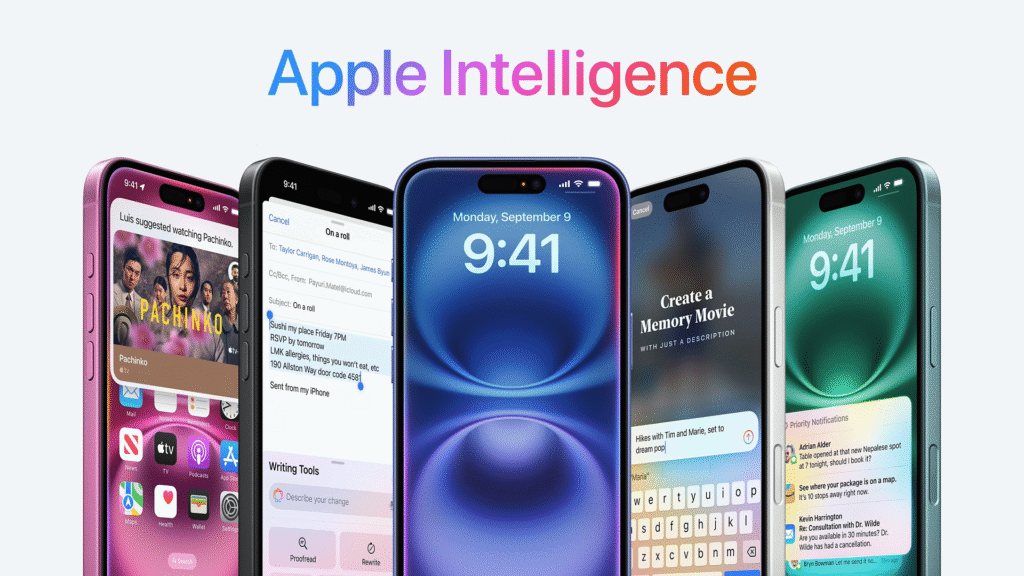
Apple is not ignorant of AI. It has its own models. It has published technical details. It has muscle. But it also has something more important: product common sense.
It knows that developing a real copilot (useful, fast, private, multimodal) is not something you can improvise. So it does what many companies should: blend in-house development with external technology without handing over complete control.
How about you? How would you choose your AI provider?
If tomorrow your company had to sign a multi-year agreement like this… how would you decide?
Here is the Checklist of the eight things you should keep in mind:
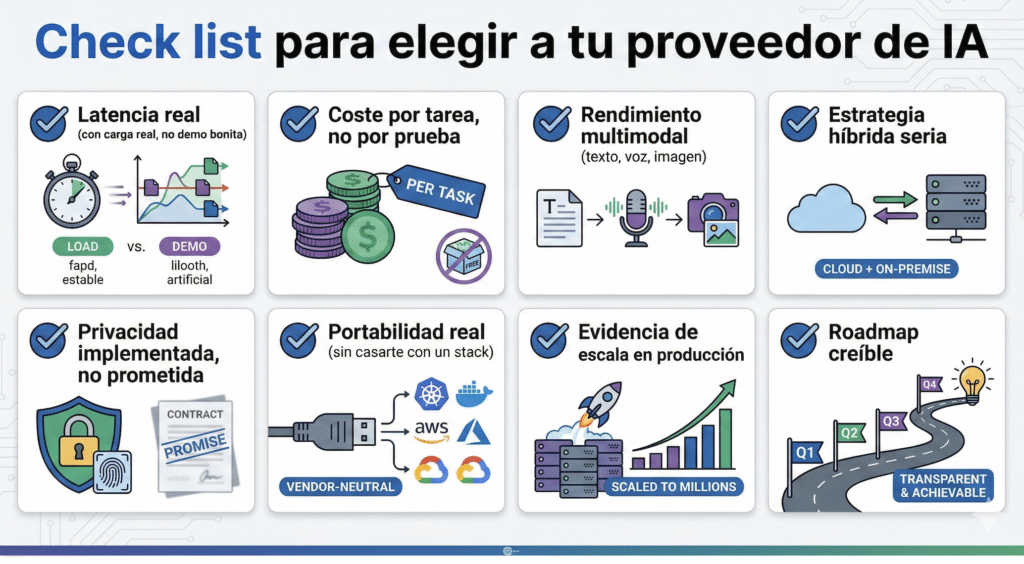
Fail on one… and it’s a future bill….
And in your case, is your company prioritizing the same as Apple… or is it being driven by fads? Do you have a hybrid strategy or do you go 100% to the cloud “because that’s the way it is”? Are you confident that your current supplier will be able to keep up with you for years to come?
Leave me your comments. I’m very interested in how you perceive these movements in your sector. And if you want me to analyze other cases, let me know!
Have a good week!


