Artificial intelligence and automation are no longer issues of the future: they are changing how, where, and who works. If the technology was once a promise, today it is a reality affecting millions of people around the globe. From robots in Asian factories to algorithms in U.S. offices, AI is reshaping entire labor markets-and it’s doing it fast.
But like any great transformation, it brings fears and opportunities. What jobs are at risk? Where are new opportunities being created? What can workers, especially young people, do to avoid being left behind?
I will try to answer these questions.
What is happening with employment?
🇺🇸 United States: Full-speed automation
In the U.S., automation is already an explicit cause of layoffs in 2025. Large companies are reducing administrative and support staff and automating basic tasks, such as customer service and software testing.
This phenomenon is not only affecting numbers: it is also reducing opportunities for those trying to enter the job market.
In this sense, junior or entry-level positions are the first to disappear when a company adopts AI.
🇪🇺 Europe: More gradual, but with clear signals
Europe is not far behind. Although the direct impact has been slower than in the United States, many companies anticipate AI-related job cuts, particularly in manufacturing and logistics.
However, there is also good news: the technology and data sectors plan to create specialized jobs, driven by public policies aimed at professionalizing the workforce.
🇱🇦 Latin America: AI in expansion… with nuances
AI is not as widespread in Latin America as in other regions, due to digital divides and limited connectivity. That has slowed massive job cuts… for now.
In this area, AI is acting more as a complement than a substitute, boosting productivity rather than eliminating jobs.
But there is a caveat: if the digital divide is not bridged, millions could be excluded from the opportunities that automation brings.
🇨🇳 Asia: Intensive Robotization and Hybrid Models
Asia leads in industrial automation. Countries such as China, Japan, and South Korea are investing in robots for manufacturing.
Where there are labor shortages, AI complements the worker.
As in the United States, office and service sectors are already seeing a drop in job openings for junior roles.

Most affected sectors and profiles
Not all jobs are equally vulnerable. AI tends to affect more:
- Repetitive or routine tasks
- Basic administrative processes
- Junior and middle management jobs
The positions at risk are:
- Basic technical support
- Traditional customer service
- Routine operators
- Entry level data analysts
- Administrative positions
In many cases, it is not a matter of “disappearing professions” but rather of certain functions within these roles being automated.
What about opportunities?
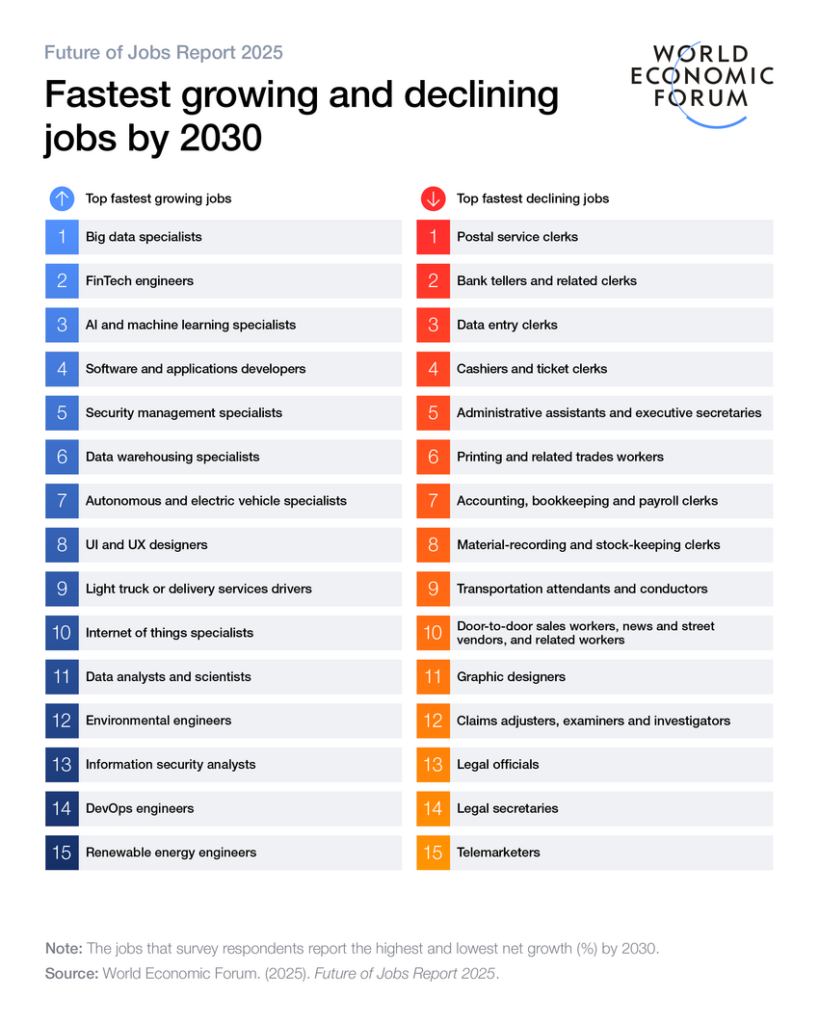
Not everything is negative. The history of technology has always been one of transformation, not pure destruction. AI is creating new jobs and opening up niches that didn’t exist before.
New fields in high demand
AI and data specialists
prompt engineers (experts in guiding AIs)
AI ethics and governance specialists
Robotics and automatic systems maintenance technicians
Advanced data analysts
Digital transformation consultants
In addition, less automatable sectors such as healthcare, education, personal care and sustainability are also growing, driven by demographic and social changes.
What students and new professionals should know
Whether you are starting your working career now or you are studying, this is what matters most:
Traditional opportunities are changing: Entry-level jobs in many industries are transforming or shrinking. A degree is no longer enough: what matters is what you can do that an AI can’t yet do for you.
Combined skills are worth more: hybrid profiles, which mix data, technology and human skills, are the most in demand. For example:
- Administration + data analysis
- Engineering + technological ethics
- Communication + storytelling for AI
Being “AI native” is a competitive advantage: it’s not about being a programmer, it’s about knowing how to collaborate with AI and use it as a tool to do your job better.
Be prepared for less linear careers: you are likely to change roles or even industries several times. Adaptability and continuous learning will be your best job insurance.

How to adapt and thrive
Here are some practical recommendations that you can apply now:
- Maintain a continuous-learning mindset: the world changes fast. Invest in your training year after year: online courses, certifications, workshops or even a postgraduate degree if you need it.
- Develop AI literacy: knowing how the most commonly used AI tools in your industry work gives you a competitive advantage and helps you better collaborate with them.
- Strengthen your human skills: machines can automate tasks… but they cannot replicate:
- Empathy
- Ethical judgment
- Critical thinking
- CreativityLeadership
These will never go out of style.
- Build a strong professional network: participate in communities, attend events, and collaborate on projects with other professionals. Your network can open doors where AI cannot.
- Accept AI as an ally, not an enemy: rather than compete with it, learn to use it to multiply your productivity. Those who master it are better positioned.

It is clear that AI and automation are reshaping employment around the world, and they are doing so at a speed that few expected.
Yes, some jobs are disappearing, and the rules of the game are changing, but new opportunities, innovative roles, and different ways of working are also emerging.
The key is not to resist change, but to anticipate it, adapt and turn technology into an ally. Collaborate with AI, rather than compete against it.
And in your case, do you think AI will be more of a threat or an opportunity for your career?
Leave me your comments and experiences, I would love to read them.
Good week!
LINKS OF INTEREST
Challenger, Gray & Christmas – Challenger Report (November 2025) – PDF
Challenger, Gray & Christmas – Dec 04, 2025: 71,321 Job Cuts on Restructurings, Closings, Economy
Reuters – US planned job cuts fall 53% in November, Challenger says (2025-12-04)
CIPD – One in six employers say AI will shrink headcount… (Labour Market Outlook)
Reuters – UK firms plan 3% pay rises… see AI hit to jobs (2025-11-10)
World Economic Forum – The Future of Jobs Report 2025 (page)
World Bank – Generative AI and Jobs in Latin America and the Caribbean
ILO – Press release: Generative AI and Jobs in Latin America and the Caribbean
Reuters – AI could eliminate up to 5% of jobs in Latin America, study finds (2024-07-31)
Brookings – Generative AI, the American worker, and the future of work (2024-10-10)
Brookings – New data show no AI jobs apocalypse-for now (2025-10-01)
Goldman Sachs – Generative AI could raise global GDP by 7% (2023-04-05)
Reuters – IBM to pause hiring in plan to replace 7,800 jobs with AI (2023-05-01)